WS2815 power consumption
A WS2815 draws 9.4 W per metre at 60 LED/m with every channel at full white, which is about a quarter less than the WS2812B it replaces - but asked for a solid colour it draws 49.5 W, slightly more than its own full-white figure, because a 12V chip regulates each LED down from 12V and burns the difference off as heat. So it cannot be sized down for effects the way a 5V strip can, and a supply chosen from an effects estimate is undersized from the day it is bought.
What it draws
Measured at full white, not taken off the datasheet - the datasheet quotes a ceiling no strip reaches. The supply column is the heavier of the two modes plus a 20% margin, which on this chip means the effects figure rather than the white one.
| Density | Length | LEDs | Full white | Solid colour | Current | Supply |
|---|---|---|---|---|---|---|
| 30/m | 1 m | 30 | 4.7 W | 5 W | 0.39 A | 5.9 W |
| 30/m | 2 m | 60 | 9.4 W | 9.9 W | 0.79 A | 11.9 W |
| 30/m | 5 m | 150 | 23.6 W | 24.8 W | 1.96 A | 29.7 W |
| 30/m | 10 m | 300 | 47.1 W | 49.5 W | 3.93 A | 59.4 W |
| 60/m | 1 m | 60 | 9.4 W | 9.9 W | 0.79 A | 11.9 W |
| 60/m | 2 m | 120 | 18.8 W | 19.8 W | 1.57 A | 23.8 W |
| 60/m | 5 m | 300 | 47.1 W | 49.5 W | 3.93 A | 59.4 W |
| 60/m | 10 m | 600 | 94.2 W | 99 W | 7.85 A | 118.8 W |
| 144/m | 1 m | 144 | 22.6 W | 23.8 W | 1.88 A | 28.5 W |
| 144/m | 2 m | 288 | 45.2 W | 47.5 W | 3.77 A | 57 W |
| 144/m | 5 m | 720 | 113 W | 118.8 W | 9.42 A | 142.6 W |
| 144/m | 10 m | 1440 | 226.1 W | 237.6 W | 18.84 A | 285.1 W |
For a length or density not on this table, the PSU calculator runs the same figures for your own configuration and picks a supply against them.
Colour costs more than white
Every rule of thumb for sizing an addressable strip says the same thing: effects draw about a third of full white, so size for effects and save the difference. That rule is false on this chip.
A 5 m WS2815 at 60 LED/m measures 49.5 W showing a solid colour against 47.1 W at full white. Colour costs marginally more.
The reason is the 12V rail it runs on. An LED needs a couple of volts; a 5V chip like the WS2812B switches each channel and the power that channel was using genuinely goes away when it turns off. A WS2815 feeds each LED from 12V through a constant-current driver, and that driver drops the difference whatever the LED is doing. Turn two channels off and the driver burns off what they were using as heat instead of light.
So there is nothing to save. The practical consequence is the only thing on this page that can cost money: a supply chosen from an effects estimate is undersized from the day it is bought, and it will hold up fine until the first time somebody picks a solid red.
The upside of the same mechanism: a WS2815 has no white-frame surge to be caught out by, so it is one of the few strips where a wall meter reading during normal use is already telling you the worst case. See why strips flicker for the chips where that is not true.
What one feed reaches
How far one pair of power wires carries the strip before the far end runs visibly under voltage. Quoted at full white, because brightness is a setting somebody can change and wiring is not.
| Density | Per metre | One feed reaches | That feed carries |
|---|---|---|---|
| 30/m | 4.7 W/m | 5 m | 1.96 A |
| 60/m | 9.4 W/m | 5 m | 3.93 A |
| 144/m | 22.6 W/m | 3.5 m | 6.59 A |
Past that length the run needs power injected at intervals rather than fed from one end. The power injection guide covers where the feeds go and how to wire them, and the voltage drop guide explains what is being lost.
Wire gauge, per feed
At 60 LED/m, one feed carries 3.93 A. This is the wire from the supply to that feed, sized to keep the loss in the cable itself under the target - not the strip's own copper.
| Supply to feed | Current | Gauge | Lost in the cable |
|---|---|---|---|
| 1 m | 3.93 A | 20 AWG | 2.18% |
| 2 m | 3.93 A | 20 AWG | 4.36% |
| 3 m | 3.93 A | 18 AWG | 4.12% |
| 5 m | 3.93 A | 16 AWG | 4.31% |
The wire gauge calculator does this for any current and distance, and names cable that carries it.
Against a WS2812B
The same job on both chips: 5 m at 60 LED/m. The interesting row is the third one.
| WS2815 (12V) | WS2812B (5V) | |
|---|---|---|
| Full white over 5 m at 60 LED/m | 47.1 W | 60.6 W |
| Current that draw puts through one feed | 3.93 A | 12.12 A |
| Running colour effects | 49.5 W | 21.1 W |
| Draw with every LED off | 8.1 W | 1.5 W |
| One feed reaches | 5 m | 2.13 m |
The WS2815 draws less at full white and a third of the current, and reaches more than twice as far on one feed. It also draws twice as much running effects, which is the case most strips spend their life in. Which one is cheaper to run depends entirely on what you put on it - and only one of the two can be sized down for it. Strip types compares the rest of the families.
Driving its data line
What the chip needs to see on DIN to read a high, against the 3.3 V an ESP32 or ESP8266 puts out. These come off the datasheets rather than the bench, and this is the one table on this page the two chips do not share.
| Chip | Needs on DIN | Published as | An ESP gives | Result |
|---|---|---|---|---|
| WS2815 | 3.5 V | minimum | -0.2 V | Out of spec, usually runs |
| GS8208 | 4.0 V | minimum | -0.7 V | Will not read reliably |
A 74AHCT125 takes the same signal to 4.4 V guaranteed, which clears both. Note that the 12V on the reel never reaches the logic pin on either chip: the WS2815 regulates its own supply down internally, so its threshold is a fraction of about 5V rather than of 12V.
Where to get a 74AHCT125
One part for every chip on this site, because the two controllers WLED runs on are both 3.3V. Sourced by part number rather than by searching for a level shifter, which returns the wrong one.
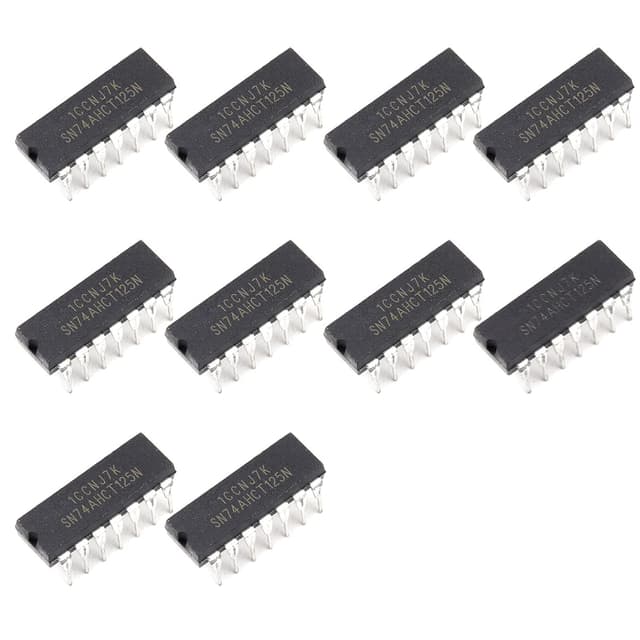
Bridgold SN74AHCT125N, 10 pack
The part the data-line arithmetic on every chip page ends at, from the listing with by far the most evidence behind it on this marketplace - 86 reviews at 4.7 and 400+ bought in the month to 2026-09-01, against single-digit review counts on the rest of the results. Ten chips because that is how this part is sold; one run needs one.
What else is worth knowing
A backup data line, and it costs something
Each pixel carries a second data input fed from the pixel before last, so one dead LED passes the signal on instead of blanking everything downstream - the failure that makes a WS2812B run go dark from the fault to the end. The spare driver draws whether or not it is ever used, which is part of why the idle figure below is what it is.
8.1 W with every LED off
Over 5 m at 60 LED/m the strip draws 8.1 W showing nothing at all. That is a floor under every figure on this page, it is heat inside the channel whether or not the lights are on, and it is most of the reason a WS2815 run feels warm at rest.
One LED per pixel, not three
Unlike the 12V WS2811 strips it sits beside, a WS2815 addresses every LED on its own - the 12V rail buys the run length without costing the resolution. That is the trade it exists to make.
12V, so one feed goes much further
One feed covers about 5 m at 60 LED/m against 2.13 m for a WS2812B, and carries 3.93 A where the 5V strip carries 12.12 A. Thinner wire, fewer injection points, and far more forgiving of a mediocre joint.
The GS8208 is the same problem
The GS8208 is a different manufacturer's answer to the same brief, and on power it behaves identically. It measures 8.8 W/m at 60 LED/m against the WS2815's 9.4 W/m, and it shows the same constant-current behaviour - a solid colour measures 44.1 W against 44.1 W at full white.
Six percent apart on draw and identical in behaviour is not two pages. Size a GS8208 from the tables above and the answer is right to within the tolerance of the strip you actually bought. The practical difference between them is availability and the data line, not power.
That data line is worth being precise about, because it is the one place the two part company. The GS8208 asks for 4.0 V on DIN where the WS2815 asks for 3.5 V, and it states that as a voltage rather than as a fraction of its supply. An ESP lands -0.7 V against it. So a wiring that runs a WS2815 unshifted - out of spec, but running - is not one that will run a GS8208.
Questions
How much power does a WS2815 strip use?
9.4 W per metre at 60 LED/m at full white, 4.7 W/m at 30 LED/m and 22.6 W/m at 144 LED/m - measured rather than taken from the datasheet, which quotes a ceiling no strip reaches. A 5 m reel at 60 LED/m is 47.1 W at full white, or 3.93 A on the 12V rail.
What size power supply does a 5 m WS2815 strip need?
59.4 W at 60 LED/m, which is the heavier of its two modes plus the usual 20% margin. Note that on this chip the heavier mode is colour effects, not full white - so unlike a 5V strip, you cannot buy a smaller supply on the grounds that you will never run white.
Does a WS2815 use less power on effects than on white?
No, and this is the thing about it that catches people out. A solid colour measures 49.5 W against 47.1 W for full white - marginally more, not a third as much. Each LED is fed from 12V through a constant-current driver, so turning two channels off leaves the driver burning off the same power as heat instead of light. A WS2812B on the same run drops to 21.1 W, which is where the "effects use a third" rule of thumb comes from; it does not apply here.
WS2815 or WS2812B?
WS2815 if the run is long, if a single dead pixel taking out the rest would be expensive to fix, or if the wiring has to be thin - one feed reaches 5 m against 2.13 m, at 3.93 A instead of 12.12 A. WS2812B if the run is short and mostly shows effects rather than white, because that is the case where the 5V chip genuinely draws less: 21.1 W against 49.5 W.
How far can a WS2815 run before it needs power injection?
About 5 m at 60 LED/m and 3.5 m at 144 LED/m, feeding from one end. Past that the far end runs visibly under voltage. The 12V rail is what buys the distance - the same strip at 5V would need a feed roughly every 2.13 m.
Is the GS8208 the same as a WS2815?
For power purposes, near enough that they share this page. A GS8208 measures 8.8 W/m at 60 LED/m against the WS2815's 9.4 W/m, and it shows the same constant-current behaviour - a solid colour costs what white costs. Size either one the same way.
Every figure on this page is computed from the same engine the PSU calculator runs on, and the per-LED draws behind it are measured rather than taken from datasheets. Sources and method: QuinLED's LED power usage charts, 12V sheet v1.06.