Wire gauge determines both how much current the wire can carry safely and how much voltage is lost getting to the strip. Undersized wire dims the far end of the run, shifts colors on RGB strips, and heats up. Sizing it properly is the difference between an install that looks even and one that fades toward the end.
Wire Gauge Calculator
Find the right wire size for your LED run. Enter your current draw and cable length to see the thinnest gauge that stays safe and keeps voltage drop under 5%.
Your run
A
Not sure? The PSU Calculator works this out from your strip length and type. On a run with injection feeds it is one feed's current that belongs here, not the whole strip's — the busiest feed, which is the one in the middle rather than the one at the end.
Distance from power supply to strip. We double it internally for the return path.
Supply voltage
The rail moves the answer more than anything else — the voltage guide compares the four.
Recommendation
18 AWG
0.82 mm²
Common for short 5V jumpers
Voltage drop3.2% · Acceptable
Cable for 18 AWG
Stranded copper only — copper-clad aluminium carries about 60% more resistance for the same gauge, so the figures above would not hold.
18 AWG
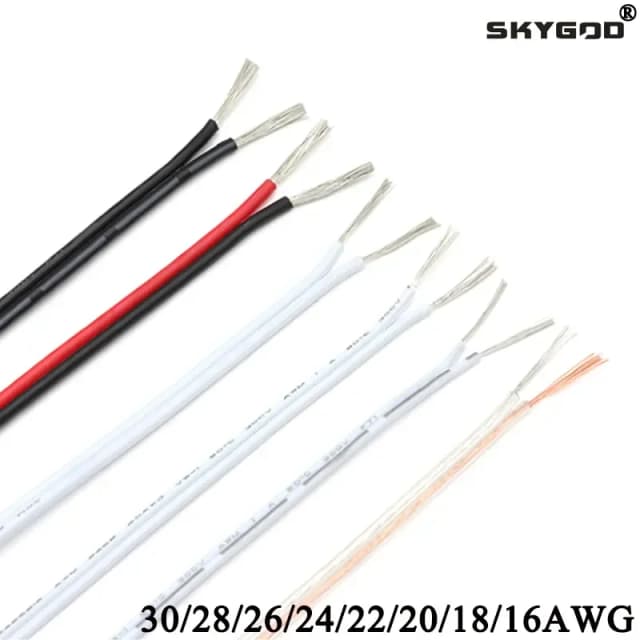
UL2468 bonded 2-pin cable 18 AWG 5m
16.4ft2-conductor pairTinned copperPVC
Covers your 6ft run with 10.4ft spare.
Bonded red/black pair, cut to the length you pick — the cheap default for signal and short power runs
Pick 18 AWG, 5 meters
18 AWG
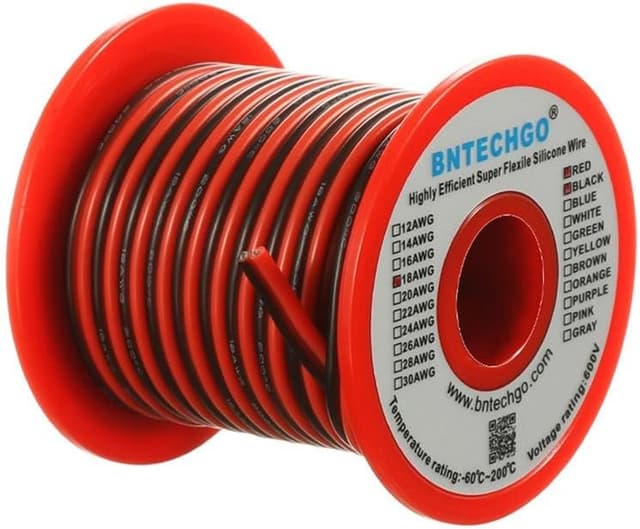
BNTECHGO 18 AWG Silicone 2-Conductor 25ft
24.9ft2-conductor pairTinned copperSilicone
Covers your 6ft run with 18.9ft spare.
Silicone stays flexible in a channel and tolerates a soldering iron better than PVC
18 AWG
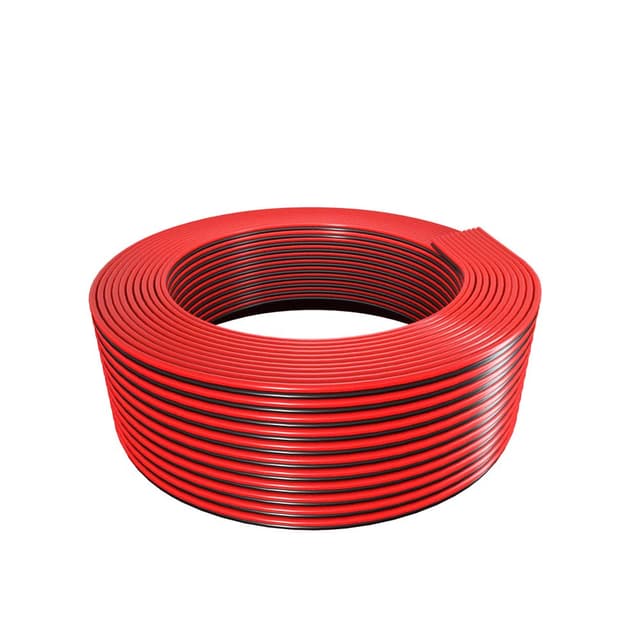
BTF-LIGHTING 18 AWG 2-Pin Extension 32.8ft
32.8ft2-conductor pairTinned copperPVC
Covers your 6ft run with 26.8ft spare.
Sold as strip extension cable rather than hookup wire, from the brand that makes the strips
All gauges at 5.0A over 6ft
Voltage drop as a percentage of 12V. Rows below the current rating are unsafe regardless of drop.
| AWG | mm² | Max current | Voltage drop | Verdict |
|---|---|---|---|---|
| 8 | 8.37 | 40A | 0.3% | Ideal |
| 10 | 5.26 | 30A | 0.5% | Ideal |
| 12 | 3.31 | 20A | 0.8% | Ideal |
| 14 | 2.08 | 15A | 1.3% | Ideal |
| 16 | 1.31 | 10A | 2.0% | Acceptable |
| 18← pick | 0.82 | 7A | 3.2% | Acceptable |
| 20 | 0.52 | 5A | 5.1% | Warning |
| 22 | 0.33 | 3A | 8.1% | Over current rating |
Quick Reference
Wire specifications and typical LED scenarios at a glance.
Wire gauge specifications
Resistance is for copper at 20°C. Current ratings are conservative figures for bundled or enclosed runs, which is how LED wiring is normally installed.
| AWG | mm² | Max current | Ω per meter | Typical use |
|---|---|---|---|---|
| 8 | 8.37 | 40A | 0.002061 | Very high current mains-side distribution |
| 10 | 5.26 | 30A | 0.003277 | High-power installations, long runs |
| 12 | 3.31 | 20A | 0.005211 | Medium-power LED strips |
| 14 | 2.08 | 15A | 0.008286 | Standard LED installations |
| 16 | 1.31 | 10A | 0.013172 | Short runs, low power |
| 18 | 0.82 | 7A | 0.02095 | Strip-to-strip jumpers, very short runs |
| 20 | 0.52 | 5A | 0.033292 | Low-current runs and data signals |
| 22 | 0.33 | 3A | 0.052939 | Data signals, minimal current |
Voltage drop thresholds
| Drop | Rating | What you see |
|---|---|---|
| Under 2% | Ideal | No perceptible difference end to end. |
| Under 5% | Acceptable | The standard target. Any difference is invisible in practice. |
| Under 10% | Warning | Noticeable dimming at the far end; white starts to warm up. |
| Over 10% | Critical | Obvious dimming and colour shift. Addressable strips may glitch. |
Common LED scenarios
| Project | Current | Voltage | Run | Wire | Drop |
|---|---|---|---|---|---|
| TV bias light, 2m WS2812B | 1.2A | 5V | 1m | 22 AWG | 2.5% |
| Under-cabinet, 3m COB | 2.4A | 24V | 2m | 22 AWG | 2.1% |
| Gaming desk, 5m WS2812B | 6.0A | 5V | 2m | 14 AWG | 4.0% |
| Room perimeter, 10m 5050 | 12.0A | 12V | 5m | 10 AWG | 3.3% |
| Staircase, 15m addressable | 9.0A | 24V | 8m | 14 AWG | 5.0% |
Compare the gaming desk and the staircase: both land on the same gauge, yet the staircase carries seven times the power over four times the distance. That is what running at 24V instead of 5V buys you — the same watts at a higher voltage means proportionally less current, and voltage drop scales with current. The voltage drop guide takes that further: what each threshold above is worth in volts on each rail, and why this table cannot tell you anything about the loss along the strip itself.
How to Calculate Wire Gauge
Three checks, in order. The calculator runs all of them; here is what each one does.
- 1
Current capacity check
First we discard any gauge that cannot carry your current safely, using conservative ampacity ratings for enclosed and bundled installations rather than optimistic free-air figures.
- 2
Voltage drop calculation
For each remaining gauge we apply Ohm's law over the round-trip wire length — V = I × R × L × 2 — and express the result as a percentage of your supply voltage.
- 3
Optimal selection
We recommend the thinnest gauge that clears both tests: adequate ampacity and voltage drop under 5%. Thinner wire is cheaper, easier to route, and easier to terminate, so there is no reason to oversize beyond that.
The formula
Voltage drop (V) = Current (A) × Resistance (Ω/m) × Distance (m) × 2That final × 2 is the part people leave out. Current has to travel to the strip along the positive conductor and return along the negative, so a 5 meter run puts 10 meters of copper in the circuit. Forgetting it halves your predicted drop and leads to wire that is one or two gauges too thin.
Divide that result by your supply voltage to get the percentage. We recommend the thinnest gauge that stays under 5% while still carrying the current safely.
Worked example
A 5 meter WS2812B strip at 12V drawing 6A, with the power supply 5 meters away:
- ▸18 AWG is rated 7A, so it clears ampacity — but at 0.02095 Ω/m the drop is 6 × 0.02095 × 10 = 1.26V, which is 10.5% of 12V. Rejected.
- ▸16 AWG gives 6 × 0.013172 × 10 = 0.79V, or 6.6%. Still over the limit. Rejected.
- ▸14 AWG gives 6 × 0.008286 × 10 = 0.50V, or 4.1%, and is rated 15A. This is the recommendation.
Questions
Common questions about wire sizing, voltage drop, and cable choice for LED installations.
Voltage drop is the potential lost to the wire's own resistance as current flows through it. The strip sees less than the power supply puts out. Keep it under 5% and the difference is invisible; past 10% you get obvious dimming, and on RGB strips a warm color cast because the blue channel needs the most voltage.
AWG (American Wire Gauge) is standard in the US, mm² everywhere else. This calculator shows both. AWG runs backwards from intuition — lower numbers are thicker. 12 AWG (3.31mm²) is considerably thicker than 18 AWG (0.82mm²).
Current has to make a round trip: out along the positive conductor and back along the negative. Both add resistance, so a 5 meter run means 10 meters of wire in the voltage drop calculation.
Silicone-insulated stranded copper is the usual choice — it stays flexible and tolerates heat well. Use tinned copper for outdoor or damp locations. Avoid copper-clad aluminium (CCA) sold as cheap 'copper' wire: it has roughly 60% more resistance for the same gauge, so these numbers will not hold.
Take the strip's watts per meter, divide by voltage to get amps per meter, then multiply by length. A 14.4W/m strip at 12V draws 1.2A/m, so 5 meters is 6A. The PSU Calculator does this for you and carries the figure straight into a wire recommendation.
Thick wire is rarely the best answer. Move the power supply closer to the strip, split the load across several shorter runs, inject power at both ends or at intervals along the strip, or step up to a higher strip voltage — 24V draws half the current of 12V for the same wattage, which cuts voltage drop by a factor of four.
They are conservative figures for wire that is bundled, run in aluminium channel, or coiled — normal conditions for LED work. Free-air chassis wiring can carry considerably more. When in doubt, the conservative number is the one to build to.