Multiple Power Supplies
Wiring a run too big for one supply: zones, grounds, gauges and fuses
One run, several supplies
A run too long for one power supply is wired as several zones, each fed by its own supply sized for that zone alone, with every negative tied together so the one data line crossing the zones keeps its reference - the power is split, the controller and its signal stay one.
Most advice on this stops at whether several supplies are allowed. They are - the real work is bookkeeping: which metres each supply owns, and which two wires still have to behave as if the install were one. This page plans the whole project. Inside a single zone, how far apart the feeds go is the power injection guide, and the PSU calculator sizes each zone's supply from its own strip and length.
The five decisions
- 1
How much power the whole run draws
Watts per metre times length, at full white - the ceiling the wiring has to survive, whatever brightness the software runs at. The PSU calculator computes it per strip and adds the 20% margin.
- 2
One supply or several
One supply carries a small or medium run. Once the draw with margin passes what a 350W-class supply provides, split into zones - each zone gets its own supply and the currents stay small enough for ordinary wire.
- 3
Where each zone begins and ends
Equal shares of the run, each supply mounted at the centre of its own share so its feeds stay short. Cut the strip's positive trace at every zone boundary; leave the data line and the ground continuous.
- 4
Grounds together, positives never
Every supply negative ties to a common ground, including the controller's, so the data signal keeps one reference across zones. No supply positive ever touches another's.
- 5
Gauge and fuse for every feed
Each feed is sized for its own current over its own distance - the wire gauge calculator takes both - and each supply's positive output gets a fuse at 125-150% of the current that zone carries.
Four installs worked out
Draw and current are at full white - the wiring is sized for the ceiling, not for the brightness the software happens to run at. Each supply is the next commercial size above its zone's draw plus 20%, and each fuse sits on that supply's positive output.
TV backlight - WS2812B 60 LED/m, 3 m
One continuous 3 m run around the back of the panel, supply on the shelf behind it, no feed longer than a metre.
The baseline: one zone, one supply. Even this small a 5V run already wants a second feed - which is spacing, not supply count, and the injection guide owns it.
Draw
36.4 W
Zones
1 × 3 m
Supply each
60W 5V
Fuse each
10A on 7.3 A
Feeds per zone
2
Per feed
5.5 A
Longest feed
1 m
Gauge
16 AWG · 2.9% drop
Plus a 7.5A fuse on each branch: the main fuse covers the whole zone, while each branch uses 16 AWG cable rated for 10 A.
Eight shelves - WS2815 60 LED/m, 8 m
Eight separate 1 m strips, one per shelf, each home-run to one supply in the cabinet base - the farthest shelf 3 m of wire away.
Separate strips in parallel, not one continuous run. Each branch carries so little that its wire is thinner than the main fuse can protect, which is what branch fuses are for.
Draw
75.4 W
Zones
1 × 8 m
Supply each
100W 12V
Fuse each
7.5A on 6.3 A
Feeds per zone
8
Per feed
0.8 A
Longest feed
3 m
Gauge
22 AWG · 2.1% drop
Plus a 1A fuse on each branch: the main fuse covers the whole zone, while each branch uses 22 AWG cable rated for 3 A.
Room perimeter - WS2811 FCOB 24V 720 LED/m, 20 m
A 20 m loop around the ceiling, split into two 10 m zones with a supply at the centre of each, so no feed exceeds 5 m.
The first plan that genuinely needs two supplies: dense 24V FCOB at 21 W/m puts the whole loop past what one sensible supply carries.
Draw
420 W
Zones
2 × 10 m
Supply each
300W 24V
Fuse each
10A on 8.8 A
Feeds per zone
2
Per feed
6.6 A
Longest feed
5 m
Gauge
16 AWG · 3.6% drop
Plus a 10A fuse on each branch: the main fuse covers the whole zone, while each branch uses 16 AWG cable rated for 10 A.
90 m of roofline - WS2811 30 LED/m, 90 m
About 300 ft of eave in one visual run, split into three 30 m zones, each supply mounted centrally in a soffit so its farthest feed is 15 m.
The permanent-install archetype. Three supplies, each owning a third of the run - and at these feed lengths the gauge, not the supply, is where the money goes.
Draw
661.5 W
Zones
3 × 30 m
Supply each
300W 12V
Fuse each
25A on 18.4 A
Feeds per zone
7
Per feed
3.1 A
Longest feed
15 m
Gauge
12 AWG · 4% drop
Plus a 5A fuse on each branch: the main fuse covers the whole zone, while each branch uses 12 AWG cable rated for 20 A.
To rework a plan around your own strip, length and distances, the PSU calculator sizes each zone and the wire gauge calculator checks each feed.
The two parts every plan above needs
Sized for one tv backlight zone — a 60W 5V supply, with a 7.5 A fuse on each feed.
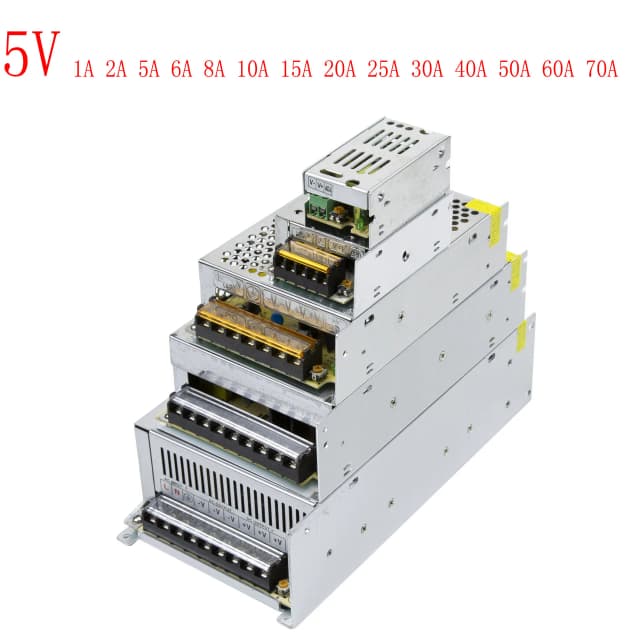
5V enclosed SMPS 5V 50W
Bare enclosed supply with screw terminals, at a fifth of the Mean Well price
Pick 10A
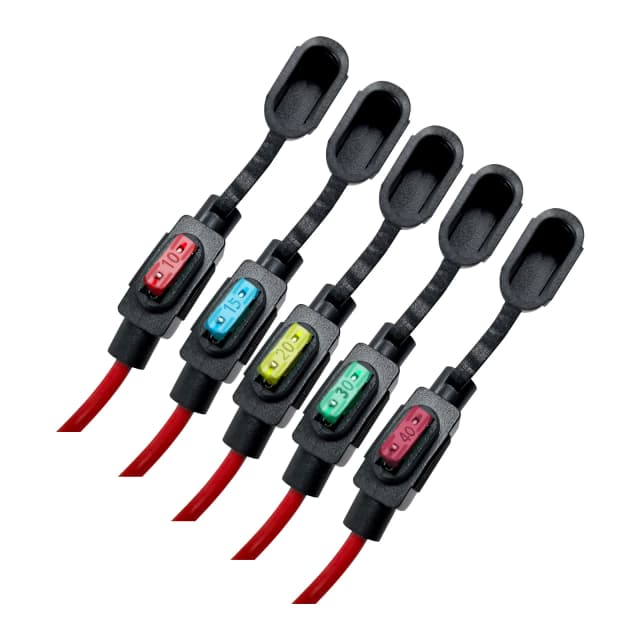
Inline blade fuse holder 16 AWG, 10 A
Gauge and fuse are one option here.
Pick 16AWG-10A
One big supply or several
The split is about distance as much as watts.
A supply exists at almost any size, so the question is not whether one big unit can be bought. It is what happens to the wiring when every feed starts from the same point. Wire is sized by distance as much as by current: put the only supply in a corner and the far side of the room is a long, thick, expensive feed; put a smaller supply at the centre of each half and every feed shortens.
| Room perimeter, 20 m | Two supplies at zone centres | One supply in a corner |
|---|---|---|
| Supply | 2 × 300W | 1 × 600W |
| Longest feed | 5 m | 10 m |
| Gauge it needs | 16 AWG | 14 AWG |
| Behind one fuse | 8.8 A | 17.5 A |
The same strip, the same feeds - only the starting point moved, and the gauge stepped up with the distance. Above the 350W class the big unit also stops being the cheap option: the next sizes up cost more per watt, need a fan, and put the whole install through one fuse, so a fault anywhere takes down everything.
The lower the voltage, the sooner the split wins. A 5V strip has a 5% budget of only 0.25V to spend on every feed, so a central supply runs out of reach within a couple of metres - which is why large 5V builds are several supplies almost by definition, and why the voltage guide sends long runs to 24V before any of this arithmetic starts.
What a zone is
A zone is the length of strip one supply owns outright.
Split the run into equal shares, one per supply, and mount each supply at the centre of its share - that halves its longest feed compared with sitting at either end. Within the zone, feeds go wherever the spacing rules put them; the injection guide works those positions through per voltage and density.
The step almost everyone misses: cut the strip's positive trace at every zone boundary. A continuous strip carries +V along its own copper, so leaving it intact quietly connects two supplies' positive outputs through the strip - the exact fault the injection guide warns against making with a wire, made by the strip itself. Cut only the positive pad at a cut line; the data line and the ground stay continuous, because the signal has to cross and the grounds are tied anyway.
Grounds together, positives never
The data signal is a voltage measured against ground.
Two supplies with separate negatives give the controller and the far zones different ideas of what zero volts is, and the difference reads as noise on the data line: random colours, usually arriving the day the second supply does. The flickering guide lists it among the data faults because that is how it announces itself.
So every supply's negative ties to a common ground - cleanest at a terminal block or bus bar, with the controller's ground on it too. The positives never join: each one leaves its own supply, through its own fuse, to its own zone, and meets nothing else. No two supplies hold exactly the same output voltage, and two joined positives push current into each other instead of into the strip.
Gauge and fuse, per feed
Each feed is sized for its own share, not for the total.
With the load split evenly, a feed carries the zone's current divided by its feed count, over its own distance back to the supply. Those two numbers are the whole input: the wire gauge calculator returns the thinnest gauge that carries the current and keeps the round-trip drop under 5%. The plans above show how different the answers get - a metre-long TV feed and a 15 m roofline feed carry similar current through very different copper.
Fuses follow the same per-zone logic. One fuse on each supply's positive output, as close to the supply as practical, rated 125-150% of the current that zone carries at full white and rounded to the nearest standard size. The ladder is coarse, so the nearest rung sometimes sits just outside the band - that is fine, because the job is only to be comfortably above the running current and below what the wiring carries:
| Plan | Current per supply | 125-150% band | Fuse |
|---|---|---|---|
| TV backlight | 7.3 A | 9.1-10.9 A | 10A |
| Eight shelves | 6.3 A | 7.9-9.4 A | 7.5A |
| Room perimeter | 8.8 A | 10.9-13.1 A | 10A |
| 90 m of roofline | 18.4 A | 23-27.6 A | 25A |
A fuse protects the wire behind it, so a branch thinner than the main fuse allows needs a fuse of its own - the shelf plan carries a 7.5A main fuse in front of 22 AWG branches rated for 3 A, which is why each shelf gets its own 1A fuse. A fuse that never blows costs a few cents; the wire it protects is inside a wall.
That principle is the whole of the fuses guide, which takes it past the zone plans here: what the busiest feed carries on runs of every size, and why the sizing rule repeated everywhere else — a fuse just above what the strip draws — leaves the feed cable unprotected on several of the runs in its comparison.
Questions
When do I need more than one power supply?
When the run's full-white draw plus a 20% margin passes what a 350W-class supply provides. Below that, one supply and enough injection feeds carry any run; above it, single supplies get expensive, need fans, and put the whole install's current through one point. Splitting into zones also halves the feed lengths, which is often worth more than the supply itself - wire is sized by distance as much as by current.
Can several power supplies share one wall outlet?
Usually, yes. The largest plan on this page - three supplies covering 662W of strip - draws about 778W at the wall at full white, which is 6.5A on a 120V circuit and 3.4A on a 230V one. A 15A circuit holds that easily; what fills a circuit is everything else already on it, not the LED supplies. The one caveat is switch-on: switching supplies pull a brief inrush many times their running current, so several on one switch can trip a breaker at the moment they all start - switch zones on separately if it does.
Can the end of the strip loop back to the start?
Yes, and on a perimeter it is the cheapest feed you will ever add: the run's two ends sit next to each other, so a short jumper from the supply feeds both at once. That is feeding both ends of one zone - the injection guide's territory - not a second supply. Only power loops; the data line still enters at one end and simply stops at the other.
Do all the supplies have to share a ground?
Whenever one controller's data crosses between zones, yes - the signal is a voltage measured against ground, and two supplies with separate negatives give it two different ideas of what zero is, which reads as random colours. Tie every negative together, including the controller's. Only fully independent zones, each with its own controller and nothing crossing between them, can skip it.
Can I mix 5V and 24V zones in one build?
Yes. Each zone's supply must match its own strip's voltage, but different zones can run different rails - a 5V accent strip and a 24V perimeter under one controller is a normal build. The grounds still all tie together, because the shared data line references ground, not the positive rail. What can never happen is one strip fed by two voltages, or any positive-to-positive connection between supplies.
Do the supplies have to be the same brand or size?
No. Each supply owns its zone outright, so a 200W unit can sit next to a 350W one from another maker. Two supplies feeding the same continuous strip must output the same nominal voltage, and the strip's positive trace should still be cut at the boundary between them - two positives joined through the strip's own copper is the same mistake as joining them with a wire.
One fuse for everything, or one per feed?
One fuse per supply positive output, always, sized at 125-150% of that zone's current. Add branch fuses only where a branch's wire is thinner than the main fuse protects: the shelf plan's supply carries 6A behind a 7.5A fuse, but each shelf's 22 AWG branch is only rated for 3A - a fault on one shelf would cook that wire long before the main fuse noticed, so each branch gets its own 1A fuse.
Does splitting into zones change how much power I need?
No. The strip draws the same wattage however many supplies feed it. Zoning changes where the power comes from and how far it travels, not how much of it there is - size each zone's supply from that zone's length plus the 20% margin, and the sum lands where one big supply would have.
Enter your own strip and length to size each zone's supply.
Open PSU Calculator