LED strip fuses
A fuse protects the cable it sits on, not the strip at the end of it - so it is sized from what that one cable carries and what that gauge can survive, which on a run with several feeds is a fraction of what the whole strip draws. That is the difference between the four sizing rules in circulation and it is not academic: a 5 m WS2812B 60 LED/m reel draws 12.12 A, so the widely repeated advice to fuse just above the load gives 15 A - fitted to a feed cable of 16 AWG rated for 10 A. The wire is the fuse in that circuit. Each of that reel's 4 feeds carries 4 A and wants 5 A.
Do I need a fuse at all
The test is not how big the supply is. It is whether the supply can deliver more current than the thinnest cable in the project can carry — because a supply that cannot is already its own fuse, and one that can will hold its full rating into a fault until something opens.
| Supply | Can deliver | On | Wire carries | Fuse? |
|---|---|---|---|---|
| 5V 2 A USB brick | 2 A | 22 AWG | 3 A | No |
| 5V 10 A desktop brick | 10 A | 20 AWG | 5 A | Yes |
| 12V 5 A brick | 5 A | 18 AWG | 7 A | No |
| 5V 60 A enclosed supply | 60 A | 16 AWG | 10 A | Yes |
| 24V 350 W enclosed supply | 14.6 A | 18 AWG | 7 A | Yes |
5V 2 A USB brick. The supply is the limit. It cannot deliver enough to overheat even the thin wire, and into a dead short it drops out or folds back. A fuse here protects nothing that is not already protected.
5V 10 A desktop brick. Borderline by design - a 10 A supply on a 5 A jumper can hold twice that wire's rating indefinitely. This is the smallest setup where the answer is genuinely yes.
12V 5 A brick. Under the wire's rating, so the supply cannot overheat this cable. Note that it is the pairing that decides it, not the size of either half.
5V 60 A enclosed supply. Six times what the feed cable can carry. Into a short this supply delivers its full rating until something opens, and if nothing does, the something is the wire.
24V 350 W enclosed supply. The high-voltage rails are not exempt. Fewer amps for the same light means thinner cable is specified, so the ratio between what the supply can push and what the wire can take stays about the same.
Notice that it is the pairing that decides, not the size of either half. A large supply on thick cable is safer than a small one on a thin jumper, which is what a threshold quoted in watts cannot say.
Four rules, four answers
Search this question and you will meet all four of these, none of them acknowledging the others. They are not equally wrong — three of them are answering "what will not blow in normal use", which is a different question from "what opens before the wire melts".
Size it from the load — from what the whole strip draws
Take the strip's full-white current and buy the next fuse above it.
WLED's own wiring documentation: "Buy a fuse that's rated just over what you expect your LED strip to draw." Electrical Engineering Stack Exchange gives the same rule with headroom - a 5 A load on a 7.5 A fuse.
The most-repeated rule and the one that fails hardest, because on an injected run the whole strip's current never passes through any single cable. Sized this way the fuse is rated for more than the wire it sits on can carry, and the table below is what that costs.
Size it from the supply — from what the power supply can deliver
Fit fuses once the supply is big enough to start a fire, and rate them near what it can push.
QuinLED, "Using fuses for increased safety", February 2019: if a supply delivers more than 150-200 W continuously, add fuses.
Right about when to fit one and wrong about what to rate it. The supply's capacity is the thing you are protecting against, not the thing you size to - a 60 A supply behind a 40 A fuse feeding 16 AWG has a fuse that will never open first.
Load times a safety factor — from what the fixtures draw, times 1.4
Amp draw at system voltage, multiplied by the number of fixtures, multiplied by 1.4.
Lumitec's fuse selection reference, which is marine wiring practice and carries an ABYC allowance for going one size above the cable's ampacity.
The closest of the three, and it is the marine convention rather than a strip-lighting one. It still starts from the load, so on a run with several feeds it lands in the same place as the first rule.
Size it from the wire — from what the cable this fuse sits on can carry
Pick the fuse from the gauge of the wire it protects, not from the light at the end of it.
The top answer on r/led and the same answer on the RV forums: "Its whole job is to prevent the WIRES from overheating and causing a fire. Select the fuse size by the wire size."
The only one of the four that describes what a fuse does. It is also the least specific, because it stops short of saying what any particular feed carries - which is the arithmetic this page adds.
Only size it from the wire describes what a fuse does. A fuse is not a guard on the strip and not a limiter on the supply — it is a deliberate weak point in one length of copper, and the only number that makes it weaker than the copper is that copper's own rating.
What your run needs
The same runs put through both rules. Every figure is full-white current, because brightness is a setting and wiring is fixed at install. The feed count comes from the injection engine, and the gauge from the wire calculator, enlarged where needed so its ampacity also covers the selected fuse for that feed.
| Run | Draws | Feeds | Per feed | Feed cable | From the load | From the cable |
|---|---|---|---|---|---|---|
| Under-desk stripWS2812B 60 LED/m, 5V | 4.85 A | 1 | 4.85 A | 16 AWG10 A max | 7.5 Awithin the rating | 7.5 A |
| One 5 m reelWS2812B 60 LED/m, 5V | 12.12 A | 4 | 4 A | 16 AWG10 A max | 15 A1.5× over | 5 A |
| 5 m of RGBWSK6812 RGBW 60 LED/m, 5V | 14.34 A | 4 | 4.73 A | 16 AWG10 A max | 20 A2× over | 7.5 A |
| 5 m at 144 LED/mWS2812B 144 LED/m, 5V | 29.09 A | 4 | 9.6 A | 12 AWG20 A max | 40 A2× over | 15 A |
| 10 m ceiling coveWS2815 60 LED/m, 12V | 7.85 A | 2 | 5.89 A | 16 AWG10 A max | 10 Awithin the rating | 7.5 A |
| 20 m room perimeterWS2815 60 LED/m, 12V | 15.7 A | 5 | 3.93 A | 16 AWG10 A max | 20 A2× over | 5 A |
| 10 m of 24V FCOBWS2814 FCOB RGBW 784 LED/m, 24V | 8.75 A | 2 | 6.56 A | 16 AWG10 A max | 10 Awithin the rating | 10 A |
The load-sized fuse is above what the feed cable can carry on 4 of these 7 rows, on every rail. On "One 5 m reel" the advice gives 15 A on cable rated for 10 A, while the busiest of its 4 feeds is carrying 4 A. In that circuit the wire is the fuse.
For "Under-desk strip", the busiest feed carries 4.85 A. Its 16 AWG cable is rated for 10 A, covering the 7.5 A fuse given by the load rule. Check the cable rating on every feed; that relationship does not hold for every run in the table.
For "10 m ceiling cove", the busiest feed carries 5.89 A. Its 16 AWG cable is rated for 10 A, covering the 10 A fuse given by the load rule. Check the cable rating on every feed; that relationship does not hold for every run in the table.
For "10 m of 24V FCOB", the busiest feed carries 6.56 A. Its 16 AWG cable is rated for 10 A, covering the 10 A fuse given by the load rule. Check the cable rating on every feed; that relationship does not hold for every run in the table.
The first row is the one that explains why this argument never gets settled. A 2 m strip has a single feed, so both rules give the same fuse and there is nothing to disagree about. The cable still has to cover that fuse rating; the table increases its gauge where needed.
How far apart they come after that is not the feed count. A feed owns the strip halfway to its neighbour on either side, so two feeds split a run three to one rather than in half — the second one reaches back to the middle and on to the far end. That is why the 2-feed rows above still fuse close to the load rule while the 4-feed ones are 1.5× apart. Dividing a run by its feeds describes the average feed and no real one, and the average is not the feed that melts.
Where the feeds go, and why a run gets the number it does, is the power injection guide. The gauge in that column comes from the wire gauge calculator, which sizes for the distance as well as the current.
A plan that looks careful
A plan of the kind posted to the WLED forums most weeks: 12 m of WS2812B 60 LED/m on a 5V 60 A supply, injected at 3 points, fused at 40 A. The fuse is close to what the run draws, which is the load rule followed correctly.
- The run draws 29.09 A, so a 40 A fuse is a sensible-looking number.
- Split across 3 feeds, the busiest carries 9.7 A — and wants a 15 A fuse, not a 40 A one.
- A 40 A fuse only protects cable of 8 AWG or thicker. That is a requirement the plan never states.
The defect is not the arithmetic — it is the condition hiding inside it. Fitting that fuse silently commits every branch behind it to 8 AWG, and nobody reading the plan has a reason to know that. Fuse the feeds individually and each gets a 15 A fuse on far cheaper wire, with the protection sitting where the fault would actually be. This is the most common way to get fusing wrong and the whole point is that it looks careful.
Where the fuses go
Always in the positive, never in the negative — a fuse in the ground opens the return while the positive stays live, which leaves the project energised and referenced to nothing, and on an addressable strip takes the data line's reference with it.
The supply's positive output — every project
In the positive lead, as close to the supply's terminal as the wiring allows.
Sized from: The current on that one cable, not the supply's rating.
Everything downstream passes through here, and this is the fuse that stands between a shorted project and a supply willing to deliver its full rating into it. Close to the terminal matters: the length of cable upstream of the fuse is the length the fuse does not protect.
Each injection feed
In the positive of every branch that leaves the distribution point.
Sized from: What that feed carries, which is a share of the run.
This is the one people skip, and it is the one the arithmetic on this page is about. Branches are thinner than the trunk, so a fuse sized for the trunk cannot protect them - a fault on one feed would cook that feed's wire long before the main fuse noticed anything. Needed wherever a branch is thinner than the main fuse protects.
The controller's own supply
In the positive feeding the controller board, where it is fed separately.
Sized from: The controller's draw, which is under an amp for an ESP32.
A small fuse here is cheap insurance on a board that is a much likelier short than a strip is, and it stops a dead controller taking the main fuse and the whole install with it. Many controllers ship with one fitted; check before adding a second in series.
The mains side
Not your job, in almost every case.
Sized from: The supply's own datasheet.
An enclosed supply has a fuse inside it and its own datasheet says so, and the wall circuit has a breaker. Adding an inline mains fuse is working on the dangerous side of the transformer to duplicate protection that is already there twice. The question comes up often on the forums; the answer is that the DC side is where the unfused wire is.
A project split into zones with a supply each fuses per zone as well as per feed — the multiple supplies guide plans four installs end to end, with the gauge and fuse for every run in them.
Choosing the part
Everything above is computed. This section is not — it is manufacturer guidance and standard practice, and it is here because the same three questions follow the sizing one everywhere it gets asked.
Blade or glass?
Automotive blade fuses, in practice. They are DC-rated to 32V, sold everywhere in every rating on the ladder, and their holders take a fuse you can replace without tools. Glass cartridge fuses work electrically at these voltages but are usually AC-rated parts, and the holders are the part that lets them down - they run hot at high current and the clips relax. Nothing rules glass out at a few amps; blade is what the ladder and the holders are built around.
QuinLED's fuse post takes the same position: any fuse suited to 12V/24V will do, and the form factor is what you find easiest to work with.
Does a 250V fuse work on a 12V strip?
Yes for the rating, but the rating is not the thing to check. A fuse's voltage figure is a maximum it can safely interrupt, so a 250V part on a 12V rail is well inside it. What matters is whether the part is rated for DC at all: AC current crosses zero a hundred times a second and helps the arc extinguish itself, and DC does not, so a fuse qualified only for AC may not reliably break a DC fault. Automotive blade fuses are DC-rated by definition, which is the simplest way past the question.
Standard fuse practice; the confusion is a recurring r/WLED thread, where the two halves of the answer get given separately and neither is wrong on its own.
How hot is too hot for the fuse itself?
A fuse carrying close to its rating runs hot and ages, which is what the 125-150% band is really buying. Littelfuse's guidance is that a fuse should see no more than 75% of its rating continuously, and that this share drops further in a warm enclosure - at 70°C it wants derating again. Sizing at 125% of the load puts it at 80% and at 150% puts it at 67%, so the band this site uses straddles that figure from both sides.
Littelfuse fuseology selection guide, reproduced by GLEDOPTO on r/WLED in a post explaining why they ship a 20 A fuse on a 15 A controller.
The holder’s own wire is part of the circuit
An inline holder does not arrive as a bare socket. It comes with its own tails already attached and you splice those into the feed, which puts them in series with everything else — so the gauge of that short lead caps the whole run. A holder with 18 AWG tails fitted to a feed sized at 16 AWG leaves the run no better than 18 AWG, and nothing on the listing says so.
WLED’s own wiring documentation makes the same point about 16 AWG tails capping an injection run. It is the one specification worth reading off a holder listing before the price, and the good news is that most of them state it: these parts are sold by gauge the way cable is.
A holder that will not throttle it
For the 16 AWG feed above, at 5 A. The calculator sizes your own.
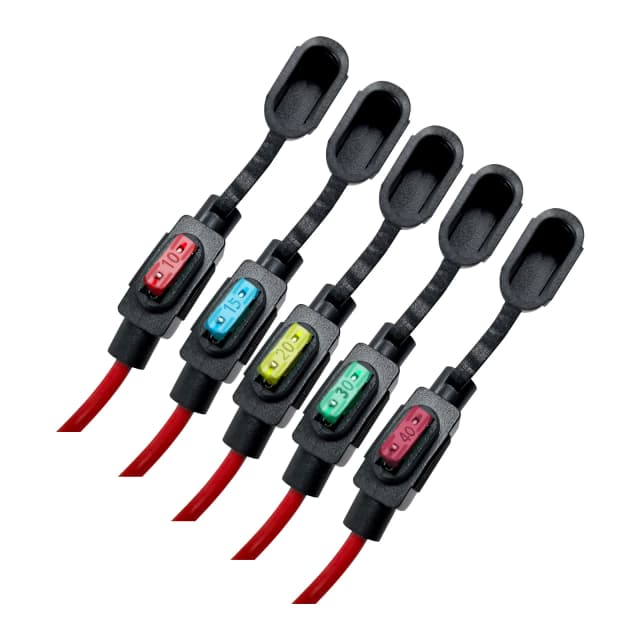
Inline blade fuse holder 16 AWG, 5 A
Gauge and fuse are one option here.
Pick 16AWG-5A
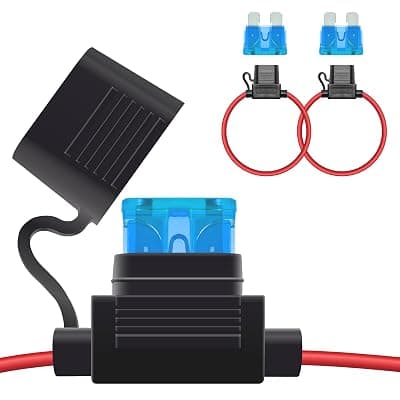
ecocstm 16 AWG inline holder
A pair — one feed and a spare.
Worth noticing that the last of those three agrees with the band this site sizes in, having been reached from the other direction. Sizing a fuse at 125–150% of the load is the same statement as running it at 67–80% of its rating, which straddles the 75% ceiling the fuse manufacturers publish. Two rules meeting in the middle is the reason to trust either.
Questions
Do I need a fuse for LED strip lights?
Only when the supply can deliver more current than the thinnest cable in the project can carry, which is the test rather than a wattage threshold. A 5V 2 A USB brick on 22 AWG cannot overheat that wire even shorted, so it is its own fuse. A 5V 60 A enclosed supply on 16 AWG can push 6 times what the cable is rated for and will keep pushing it into a fault until something opens. Published advice draws this line in watts - "over 150 W, fit fuses" - which is a reasonable proxy and gets the pairing wrong at both ends.
What size fuse for a 5 m LED strip?
It depends on where the fuse sits, which is why the question has no single answer. A 5 m WS2812B 60 LED/m reel draws 12.12 A in total, but the injection engine puts 4 feeds on that run and the busiest of them carries 4 A - so every feed gets a 5 A fuse on 16 AWG cable, sized from the busiest because they take one part number between them, and the supply's own output fuse is sized from whatever the trunk cable to the distribution point carries. Fitting one 15 A fuse for the whole reel, which is what sizing from the load gives, leaves every one of those feeds unprotected.
Should the fuse match the power supply or the LED strip?
Neither. It matches the cable it is fitted to. The supply's rating tells you what a fault could deliver, and the strip's draw tells you what the fuse must not open under - but the number you size from is the ampacity of that particular run of wire, because the wire is what burns. On a project with one supply and one short cable those three numbers nearly coincide, which is why the distinction goes unnoticed until somebody injects power.
Can I use one big fuse instead of one per feed?
Only if every branch is as thick as the trunk. A single fuse sized for the trunk cable is blind to a fault on any branch thinner than that: the branch will carry the main fuse's full rating without opening it, and its wire is rated for less. Take "One 5 m reel" from the table above - a fuse sized from the load is 15 A against feed cable rated for 10 A, 1.5 times over. If you would rather fit one fuse than several, the way to earn that is to run every feed in the same gauge as the trunk, not to fit a bigger fuse.
Where exactly does the fuse go?
In the positive lead, as close to the supply as the wiring allows - the cable upstream of the fuse is the cable it does not protect. On a run with injection feeds, that main fuse is joined by one per branch at the distribution point. Not in the negative: a fuse in the ground opens the return while the positive stays live, which leaves the whole project energised and referenced to nothing, and on an addressable strip it also removes the data line's reference.
Will a fuse stop my strip from being damaged?
No, and it is worth being clear about it. A fuse is slow compared with semiconductors - the LEDs and the controller will fail long before it opens. What it protects is the cable, and through the cable, the building. Size it to save the wire and treat anything it saves downstream as luck.
Does dimming the strip let me fit a smaller fuse?
No. Brightness is a setting anyone can change and wiring is fixed at install, so every figure on this page is full-white current for the same reason the connector ratings are. A fuse sized for a dimmed strip is a fuse that opens the first time somebody drags the slider to 100%, and a nuisance blow teaches people to fit a bigger fuse, which is how an installation ends up with the fuse it should never have had.
Every current, gauge and fuse size on this page is computed from the same engine the PSU calculator runs on, using measured per-LED draws rather than datasheet ceilings — see the chip reference for what each chip draws. The fuse hardware notes are manufacturer and community guidance, sourced in their own section, and are the only claims here we did not derive. A fuse protects cable; if the run is also dim at the far end that is a voltage drop problem, and a joint running hot is the connectors one.