SK6812 RGBW power consumption
An SK6812 RGBW draws 14.3 W per metre at 60 LED/m with all four channels at full output, or 71.7 W over a 5 m reel. The fourth die is an addition rather than a substitution, which is the thing worth knowing about this chip: the same strip lit RGB-only measures 44.7 W, so asking for white as well costs 60% on top. Running colour effects the gap all but closes - 16.8 W against 16.9 W - because the white die is dark whenever the strip is showing a colour. So the white channel costs nothing until you ask for it and more than half again when you do, and a supply sized from an RGB figure holds up until the first warm white scene.
What it draws
Measured with all four channels lit, which is what full output means on an RGBW strip. The supply column is that figure plus a 20% margin.
| Density | Length | LEDs | Full output | Colour effects | Current | Supply |
|---|---|---|---|---|---|---|
| 30/m | 1 m | 30 | 7.2 W | 1.7 W | 1.43 A | 8.6 W |
| 30/m | 2 m | 60 | 14.3 W | 3.4 W | 2.87 A | 17.2 W |
| 30/m | 5 m | 150 | 35.9 W | 8.4 W | 7.17 A | 43 W |
| 30/m | 10 m | 300 | 71.7 W | 16.8 W | 14.34 A | 86 W |
| 60/m | 1 m | 60 | 14.3 W | 3.4 W | 2.87 A | 17.2 W |
| 60/m | 2 m | 120 | 28.7 W | 6.7 W | 5.74 A | 34.4 W |
| 60/m | 5 m | 300 | 71.7 W | 16.8 W | 14.34 A | 86 W |
| 60/m | 10 m | 600 | 143.4 W | 33.6 W | 28.68 A | 172.1 W |
| 144/m | 1 m | 144 | 34.4 W | 8.1 W | 6.88 A | 41.3 W |
| 144/m | 2 m | 288 | 68.8 W | 16.1 W | 13.77 A | 82.6 W |
| 144/m | 5 m | 720 | 172.1 W | 40.3 W | 34.42 A | 206.5 W |
| 144/m | 10 m | 1440 | 344.2 W | 80.5 W | 68.83 A | 413 W |
For a length or density not on this table, the PSU calculator runs the same figures for your own configuration and picks a supply against them.
What the white channel costs
The white die is a fourth emitter in the same package, not a different way of driving the first three. So it adds.
Over 5 m at 60 LED/m, the RGB-only SK6812 measures 44.7 W at full white. The RGBW measures 71.7 W with its white channel lit alongside the colour ones — 60% more, for the same length of strip.
Now the part that surprises people. Running colour effects, the two strips draw the same: 16.8 W on the RGBW against 16.9 W on the RGB. Identical, because during a colour effect the white die is dark and the strip is doing exactly what the RGB one is doing.
Which gives the rule for sizing it: the white channel costs nothing until you ask for white, and more than half again the moment you do. A supply chosen from an RGB figure, or from a meter reading taken while the strip ran effects, is correct right up until the first warm white scene — and that scene is usually why the strip was bought.
Why the listing says 18 W/m
Most SK6812 listings quote 18 W/m and most boxes print a wide range instead of a number. Neither is a measurement, and the two disagree with each other for a reason.
The 18 W/m is arithmetic: the datasheet's maximum per LED, multiplied by 60. It is what the part is permitted to draw. Measured, the same strip runs 14.3 W/m — a sixth under the ceiling, and that gap is real money on a supply.
The range on the box is answering a different question: the span between a dim scene and everything at full, on a reel whose length the printer did not know. Between 16.8 W running effects and 71.7 W flat out over 5 m, those are the two numbers worth sizing between.
What one feed reaches
How far one pair of power wires carries the strip before the far end runs visibly under voltage. Quoted at full output, because brightness is a setting somebody can change and wiring is not.
| Density | Per metre | One feed reaches | That feed carries |
|---|---|---|---|
| 30/m | 7.2 W/m | 2.5 m | 3.58 A |
| 60/m | 14.3 W/m | 2.13 m | 6.09 A |
| 144/m | 34.4 W/m | 1.75 m | 12.05 A |
These are the shortest reaches of any chip in this reference, and that is the 5V rail rather than the chip. A standard 5 m reel at 60 LED/m needs feeding in more than one place before it is switched on, not after somebody notices the far end is pink. The power injection guide covers where the feeds go, and the voltage drop guide explains what is being lost.
Wire gauge, per feed
At 60 LED/m, one feed carries 6.09 A. This is the wire from the supply to that feed, sized to keep the loss in the cable itself under the target — not the strip's own copper. The gauges are heavy because the current is: this is what 5V costs you.
| Supply to feed | Current | Gauge | Lost in the cable |
|---|---|---|---|
| 1 m | 6.09 A | 16 AWG | 3.21% |
| 2 m | 6.09 A | 14 AWG | 4.04% |
| 3 m | 6.09 A | 12 AWG | 3.81% |
| 5 m | 6.09 A | 10 AWG | 3.99% |
The wire gauge calculator does this for any current and distance, and names cable that carries it.
Against a WS2814
The two addressable RGBW families, over the same job: 5 m at 60 LED/m. Almost the same light, and a completely different wiring job.
| SK6812 RGBW (5V) | WS2814 (12V) | |
|---|---|---|
| Full white over 5 m at 60 LED/m | 71.7 W | 81 W |
| Current that draw puts through one feed | 14.34 A | 6.75 A |
| Running colour effects | 16.8 W | 24.8 W |
| Draw with every LED off | 1.9 W | 5.7 W |
| One feed reaches | 2.13 m | 4.25 m |
The SK6812 draws slightly less and carries more than twice the current, reaching half as far per feed. What it buys with that is resolution: every LED is its own pixel, where the WS2814 addresses three at a time. Short and detailed, SK6812; long, WS2814. Strip types compares the rest of the families.
Driving its data line
Its DIN pin reads a high at 3.4 V, stated as a voltage rather than as a fraction of its supply. An ESP32 or ESP8266 puts out 3.3 V, which is 0.1 V short of it. That is out of spec and it usually runs anyway, which is what makes it worth fixing before a long run or a cold room finds it: a 74AHCT125 takes the signal to 4.4 V guaranteed.
One caveat the arithmetic hides: this is the one chip family here whose figure is published as a typical rather than a guaranteed minimum, and the datasheet calls it a flip threshold rather than VIH. So it describes where one sample switched, not what the reel promises, and the 0.1 V gap is softer than it looks in both directions. The WWA shares the die and the same figure.
Where to get a 74AHCT125
One part for every chip on this site, because the two controllers WLED runs on are both 3.3V. Sourced by part number rather than by searching for a level shifter, which returns the wrong one.
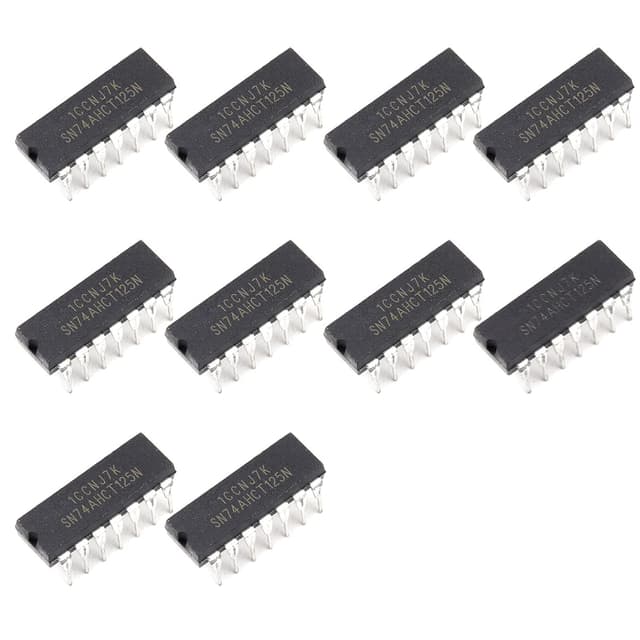
Bridgold SN74AHCT125N, 10 pack
The part the data-line arithmetic on every chip page ends at, from the listing with by far the most evidence behind it on this marketplace - 86 reviews at 4.7 and 400+ bought in the month to 2026-09-01, against single-digit review counts on the rest of the results. Ten chips because that is how this part is sold; one run needs one.
What else is worth knowing
The 18 W/m in the listings is a ceiling, not a measurement
It is 0.3 W per LED - three channels at 20 mA on a 5V rail, which is what the datasheet allows for - multiplied by 60. Nothing on the bench reaches it: measured, the same strip draws 14.3 W/m. That is also why the number printed on the box is usually a wide range rather than a figure. Size from the measured column on this page and you are still ahead of the strip, without paying for a supply a third bigger than the one you need.
14.34 A on a 5V rail, and 2.13 m per feed
71.7 W over 5 m at 60 LED/m is 14.34 A, and 5V is where current becomes the whole problem: the same watts on a 12V rail would be 5.98 A. One feed covers about 2.13 m before the far end is visibly under voltage, and 1.75 m at 144 LED/m. On this chip power injection stops being optional and becomes the design.
1.9 W with every LED off
Over 5 m at 60 LED/m the strip draws 1.9 W showing nothing at all - about 17 kWh a year on a run left powered around the clock. It is the ICs being awake rather than the LEDs being lit, so it is a floor under every figure on this page.
Four channels means a third more data
Each pixel takes 32 bits rather than 24, so the same length of strip takes a third longer to clock out and the maximum frame rate drops accordingly. The controller also has to be told the strip is RGBW before the colours land in the right order. Neither costs power, but both are why a strip that works fine as RGB can look wrong the first time it is driven as RGBW.
The WWA is the same strip, dimmed differently
The SK6812 WWA is the same package carrying warm white, cool white and amber instead of red, green, blue and white. Three dies rather than four, and it draws 11% less for it: 12.8 W/m at 60 LED/m against the RGBW's 14.3 W/m. The tables above still size it — they just leave that much in hand.
The one number that does move is what happens below full output. There is no colour on a WWA strip to switch off, so dimming is the only lever there is, and its own worst case sits at 35% of full against the RGBW's 23%. In practice: size a WWA from the full-output column and treat anything below it as headroom rather than as a saving you can buy against.
Questions
How much power does an SK6812 RGBW strip use?
14.3 W per metre at 60 LED/m with all four channels at full, 7.2 W/m at 30 LED/m and 34.4 W/m at 144 LED/m. A 5 m reel at 60 LED/m is 71.7 W, or 14.34 A on the 5V rail. Those are bench measurements; the 18 W/m quoted on most listings is the datasheet ceiling rather than a reading.
Does the white channel replace the RGB draw or add to it?
It adds. The same strip measures 44.7 W lit RGB-only and 71.7 W with the white die as well, over 5 m at 60 LED/m - 60% more. The white die is a fourth emitter in the package rather than a different way of driving the first three, so full output means all four are on.
What size power supply does a 5 m SK6812 RGBW strip need?
86 W at 60 LED/m, which is full output plus the usual 20% margin. At 144 LED/m the same length wants 206.5 W. This chip derates hard - colour effects measure 16.8 W, 23% of full - so a strip that genuinely never shows white can be sized well under that. The risk is that "never shows white" is a promise about the future, and the white channel is the reason people buy the strip.
Why does the packaging say 30-120W when the listing says 18W per metre?
Because they are answering different questions and neither is a measurement. 18 W/m is 0.3 W per LED, the datasheet ceiling, times 60 - it is what the part is allowed to draw. A wide range on the box is the span between a dim scene and everything at full on a reel whose length the printer did not know. Measured, a 5 m reel at 60 LED/m runs 16.8 W on colour effects and 71.7 W flat out, and those two numbers are the ones to size between.
SK6812 RGBW or WS2812B?
SK6812 RGBW if you want usable white, which is the whole reason it exists - white mixed from red, green and blue is tinted and inefficient, and a dedicated die is neither. It costs more to run: 71.7 W against a WS2812B's 60.6 W over the same 5 m, and a third more data per pixel. WS2812B if the strip only ever shows colour, because then the fourth die is doing nothing and you are paying to carry it. Both are 5V with the same timing, so the controller does not care either way.
SK6812 RGBW or WS2814?
Both are addressable RGBW, and the difference is the rail rather than the light. The SK6812 pulls 14.34 A where the WS2814 pulls 6.75 A, and one feed reaches 2.13 m against 4.25 m - so a run of any length is a wiring job on the SK6812 and an ordinary install on the WS2814. What you get back is resolution: the SK6812 addresses every LED, the WS2814 every three. Short and detailed, SK6812; long, WS2814.
Is the SK6812 WWA the same strip?
Same package, and 11% under it on draw - 12.8 W/m against 14.3 W/m at 60 LED/m, which is three white dies against three colour ones and a white. It shares this page because nobody searches its power, not because the figures match. What differs beyond the draw is what derating means. It carries warm white, cool white and amber rather than RGB plus white, so there is no colour to switch off and dimming is the only lever: its own effects figure is 35% of full against the RGBW's 23%. Size it from the full-output column and dim from there.
Every figure on this page is computed from the same engine the PSU calculator runs on, and the per-LED draws behind it are measured rather than taken from datasheets. Sources and method: QuinLED's LED power usage charts, 5V sheet v1.05. Other chips: the chip reference.