WS2814 power consumption
A WS2814 draws 16.2 W per metre at 60 LED/m with all four channels at full white, and it draws that whether the reel is the 12V or the 24V version - the rail changes the current rather than the power, so a 5 m run pulls 3.38 A at 24V against 6.75 A at 12V for the same light. Two things about it catch people out. It is addressed in groups of 3, so 60 LED/m is 20 pixels per metre rather than 60, and the smaller number is the one your controller wants. And unlike the WS2815 it shares a rail with, it derates normally: colour effects measure 24.8 W against 81 W at full white, so the 12V exception is the single-addressable chip and not the rail.
What it draws
Measured with all four channels lit, not taken off the datasheet - the datasheet quotes a ceiling no strip reaches. These watts hold on either rail; the current column is the 12V one, and 24V halves it. The supply column is full white plus a 20% margin.
| Density | Length | LEDs | Pixels | Full white | Effects | Current at 12V | Supply |
|---|---|---|---|---|---|---|---|
| 30/m | 1 m | 30 | 10 | 8.1 W | 2.5 W | 0.68 A | 9.7 W |
| 30/m | 2 m | 60 | 20 | 16.2 W | 5 W | 1.35 A | 19.4 W |
| 30/m | 5 m | 150 | 50 | 40.5 W | 12.4 W | 3.38 A | 48.6 W |
| 30/m | 10 m | 300 | 100 | 81 W | 24.8 W | 6.75 A | 97.2 W |
| 60/m | 1 m | 60 | 20 | 16.2 W | 5 W | 1.35 A | 19.4 W |
| 60/m | 2 m | 120 | 40 | 32.4 W | 9.9 W | 2.7 A | 38.9 W |
| 60/m | 5 m | 300 | 100 | 81 W | 24.8 W | 6.75 A | 97.2 W |
| 60/m | 10 m | 600 | 200 | 162 W | 49.6 W | 13.5 A | 194.4 W |
| 144/m | 1 m | 144 | 48 | 38.9 W | 11.9 W | 3.24 A | 46.7 W |
| 144/m | 2 m | 288 | 96 | 77.8 W | 23.8 W | 6.48 A | 93.3 W |
| 144/m | 5 m | 720 | 240 | 194.4 W | 59.5 W | 16.2 A | 233.3 W |
| 144/m | 10 m | 1440 | 480 | 388.8 W | 119 W | 32.4 A | 466.6 W |
For a length or density not on this table, the PSU calculator runs the same figures for your own configuration, on either rail, and picks a supply against them.
Pixels, not LEDs
One WS2814 IC drives 3 LEDs. That is also why the strip is only cuttable every 3: the group is the smallest thing on it that can be a different colour.
So a 5 m reel at 60 LED/m is 300 LEDs and 100 pixels, and the pixel count is the one your controller wants. The LED count is the number on the listing, which is why it is the one people reach for.
Enter 300 where 100 belongs and the strip does not throw an error - it just addresses the first third of itself and leaves the rest dark, with every effect running over a third of the length you laid out. That symptom reads like a broken strip or a failed data line, which is why it costs people an evening.
The same arithmetic runs the other way when you size the supply: power is drawn per LED, not per pixel, so the 300 is the number that matters there. The table above carries both columns for that reason.
12V or 24V
The WS2814 is sold as both a 12V and a 24V reel, and they measure within about 2% of each other over the same run - the draw is set by the die rather than by the supply. What the rail buys is reach.
| Density | Per metre | One feed reaches at 12V | At 24V | That feed carries |
|---|---|---|---|---|
| 30/m | 8.1 W/m | 5 m | 10 m | 3.38 A |
| 60/m | 16.2 W/m | 4.25 m | 8.5 m | 5.74 A |
| 144/m | 38.9 W/m | 3.5 m | 7 m | 11.34 A |
Doubling the rail doubles what one feed covers and halves the current behind it, which is thinner wire and fewer injection points for the same light. Buy 12V if the controller and supply you already own are 12V; buy 24V if the run is long. The voltage guide makes that argument properly, and the power injection guide covers where the feeds go once one is not enough.
Wire gauge, per feed
At 60 LED/m on 12V, one feed carries 5.74 A. This is the wire from the supply to that feed, sized to keep the loss in the cable itself under the target - not the strip's own copper. On 24V the same strip pulls half the current, so a run at this distance takes thinner cable.
| Supply to feed | Current | Gauge | Lost in the cable |
|---|---|---|---|
| 1 m | 5.74 A | 18 AWG | 2% |
| 2 m | 5.74 A | 18 AWG | 4.01% |
| 3 m | 5.74 A | 16 AWG | 3.78% |
| 5 m | 5.74 A | 14 AWG | 3.96% |
The wire gauge calculator does this for any current and distance, and names cable that carries it.
Against an SK6812 RGBW
The two addressable RGBW families, over the same job: 5 m at 60 LED/m. The rows that decide it are the second and the last.
| WS2814 (12V) | SK6812 RGBW (5V) | |
|---|---|---|
| Full white over 5 m at 60 LED/m | 81 W | 71.7 W |
| Current that draw puts through one feed | 6.75 A | 14.34 A |
| Running colour effects | 24.8 W | 16.8 W |
| Draw with every LED off | 5.7 W | 1.9 W |
| One feed reaches | 4.25 m | 2.13 m |
On raw draw there is not much in it. The difference is what that draw costs you to wire: the SK6812 RGBW pulls 14.34 A where the WS2814 pulls 6.75 A, and needs a feed roughly every 2.13 m against 4.25 m. What you give up for that is resolution - the SK6812 addresses every LED, the WS2814 every 3. The other RGBW part on this rail is the TM1814, which is a different kind of decision: its draw is a current level the controller sends it rather than a figure the strip has. Strip types compares the rest of the families.
Driving its data line
The datasheet gives the threshold as a fraction of the chip's logic supply - 0.7 of it, as a guaranteed minimum - which works out at 3.5 V on DIN. An ESP32 or ESP8266 puts out 3.3 V, which is 0.2 V short of it. That is out of spec and it usually runs anyway, which is what makes it worth fixing before a long run or a cold room finds it: a 74AHCT125 takes the signal to 4.4 V guaranteed.
The supply that fraction is taken of is not the rail, which is the thing that catches people out on a 12V or 24V reel: the datasheet names pin 7 the logic power supply and rates it 3.7-5.3 V, so the strip regulates down to about 5V and the threshold follows that rather than the 12V or 24V you wired in. The FCOB reel carries the same driver IC and the same figure.
Where to get a 74AHCT125
One part for every chip on this site, because the two controllers WLED runs on are both 3.3V. Sourced by part number rather than by searching for a level shifter, which returns the wrong one.
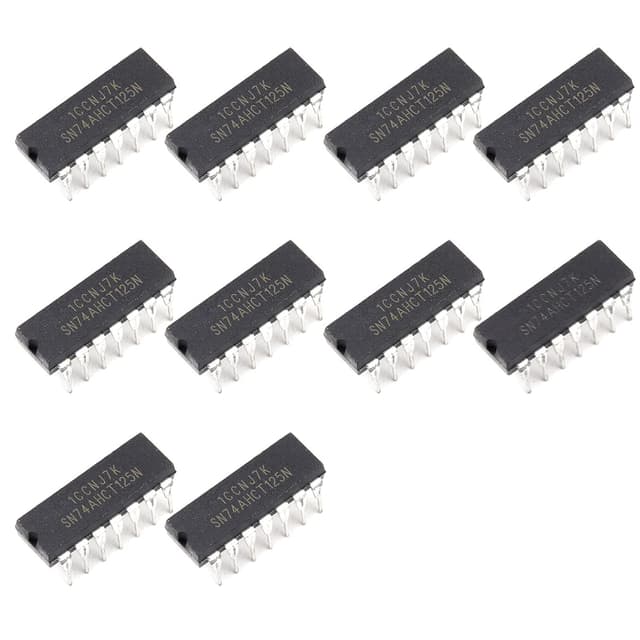
Bridgold SN74AHCT125N, 10 pack
The part the data-line arithmetic on every chip page ends at, from the listing with by far the most evidence behind it on this marketplace - 86 reviews at 4.7 and 400+ bought in the month to 2026-09-01, against single-digit review counts on the rest of the results. Ten chips because that is how this part is sold; one run needs one.
What else is worth knowing
20 pixels per metre, not 60
One IC drives 3 LEDs, which is also why the strip is only cuttable every 3. A 5 m reel at 60 LED/m is 300 LEDs and 100 pixels, and it is the pixel count a controller is asking for. Entering the LED count instead leaves two thirds of the strip unaddressed and every effect running at a third of the length you expected - the single most common way this chip is set up wrong.
Four channels, so full output is RGB plus white
The white die sits in the same package rather than being mixed from the colour channels, which is the point of an RGBW strip: a real white instead of an approximation, at a colour temperature the strip was built for. It also means full output is all four channels lit at once, so the worst case is higher than the same strip's RGB-only white and every figure here is quoted with the white channel on.
5.7 W with every LED off
Over 5 m at 60 LED/m the strip draws 5.7 W showing nothing at all. That is a floor under every figure on this page and it is the same on either rail, because it is the ICs rather than the LEDs.
12V and 24V are the same strip, bought for different reach
The draw per LED is a property of the die, so the two rails cost the same watts - what changes is the current behind them and how far one feed carries it. At 60 LED/m one feed reaches 4.25 m on 12V and 8.5 m on 24V, carrying 6.75 A on the first and 3.38 A on the second. Pick the rail for the run length, not for the power bill.
The FCOB version
Same controller, different strip: a 24V FCOB reel is a continuous line of light rather than dots, and it is sold and cut by the metre. It measures 21.3 W/m at full output on the bench, against the 21 W/m the listings quote - size from the larger figure.
| Length | Full white | Effects | Current | Supply |
|---|---|---|---|---|
| 1 m | 21.3 W | 6.1 W | 0.89 A | 25.6 W |
| 2 m | 42.6 W | 12.2 W | 1.78 A | 51.1 W |
| 5 m | 106.5 W | 30.6 W | 4.44 A | 127.8 W |
| 10 m | 213 W | 61.1 W | 8.88 A | 255.6 W |
One feed covers about 7 m of it, carrying 6.21 A. The emitter count on the listing - 784 per metre on this one - is a count of LEDs, not of pixels: they are driven in zones, and the zone size is the number to look for on your own listing. It also derates harder than the 5050 does, to 29% of full output on effects against 31%.
Questions
How much power does a WS2814 strip use?
16.2 W per metre at 60 LED/m at full white, 8.1 W/m at 30 LED/m and 38.9 W/m at 144 LED/m, with all four channels lit. A 5 m reel at 60 LED/m is 81 W, which is 6.75 A on the 12V rail or 3.38 A on 24V. These are bench measurements rather than the datasheet ceiling, which no strip reaches.
What size power supply does a 5 m WS2814 strip need?
97.2 W at 60 LED/m - full white plus the usual 20% margin - and the same figure on either rail, because the rail does not change the watts. At 144 LED/m the same length wants 233.3 W. Unlike a WS2815, this chip does derate, so a strip that genuinely never shows white can be sized nearer its 24.8 W effects figure - at the cost of browning out the day somebody turns white on.
Is the 12V WS2814 different from the 24V one?
Not in what it draws. The two measure within about 2% of each other over the same run, because the draw is set by the die rather than by the rail. What changes is current and reach: a 5 m run at 60 LED/m pulls 6.75 A at 12V against 3.38 A at 24V, and one feed covers 4.25 m against 8.5 m. Buy 24V for a long run and 12V for whatever your controller and supply already are.
How many pixels should I set for a WS2814 in WLED?
A third of the LED count. One IC drives 3 LEDs, so a 5 m reel at 60 LED/m is 300 LEDs and 100 pixels. Enter the pixel count. The LED count is the number printed on the listing and the one people reach for first, and using it is why an effect stops a third of the way along the strip.
SK6812 RGBW or WS2814?
WS2814 where the run is long or the wiring has to be thin: one feed reaches 4.25 m at 12V against 2.13 m for the 5V SK6812, carrying 6.75 A instead of 14.34 A. SK6812 where you need per-LED control, because it addresses every LED where the WS2814 addresses every 3 - and where the strip is short enough that 14.34 A is not a wiring problem. On raw draw they are close: 81 W against 71.7 W over 5 m.
Is the WS2814 FCOB the same as the 5050 WS2814?
Same controller, different strip. The FCOB reel is a continuous line of light rather than dots, it runs at 24V, and it measures 21.3 W/m against the 5050's 16.2 W/m at 60 LED/m - so a 5 m COB reel wants a 127.8 W supply. It also derates further, to 29% of full white on effects. Size it per metre; the emitter count on the listing is not a pixel count.
Every figure on this page is computed from the same engine the PSU calculator runs on, and the per-LED draws behind it are measured rather than taken from datasheets. Sources and method: QuinLED's LED power usage charts, 12V sheet v1.06 and 24V sheet v1.07. Other chips: the chip reference.