TM1814 power consumption
A TM1814 draws 22.1 W per metre at 60 LED/m with all four channels at full white - but on this chip that is a setting rather than a specification. Its constant-current level is sent to it in the first eight bytes of the data stream, anywhere from 6.5 to 38 mA per channel across 64 steps, and it applies to every IC on the run. WLED sends 22.5 mA and gives you no way to change it, which is what every figure on this page is quoted at; Adafruit's library defaults to the lowest 6.5 mA. Between those ends the same reel draws 5.5 times as much for the same colours, so a W/m figure found anywhere - including on the box - is a figure for somebody else's controller until you know what current it assumed.
What it draws
All four channels lit, at the 22.5 mA per channel WLED sets. The watts are the same on either rail - the 6-LED groups on 24V put twice as many dies behind the same current - so only the current column changes. The supply column is full white plus a 20% margin.
| Length | LEDs | Pixels at 12V | Full white | Effects | At 12V | At 24V | Supply |
|---|---|---|---|---|---|---|---|
| 1 m | 60 | 20 | 22.1 W | 8.3 W | 1.84 A | 0.92 A | 26.6 W |
| 2 m | 120 | 40 | 44.3 W | 16.7 W | 3.69 A | 1.84 A | 53.1 W |
| 5 m | 300 | 100 | 110.7 W | 41.7 W | 9.22 A | 4.61 A | 132.8 W |
| 10 m | 600 | 200 | 221.4 W | 83.5 W | 18.45 A | 9.22 A | 265.7 W |
60 LED/m is the only density these reels are sold in, on either rail. For a length between the rows, the PSU calculator runs the same figures and picks a supply against them - at this same current setting, which is the assumption the next section is about.
The draw is a setting
Every other chip on this site draws what it draws. A TM1814 is told: the first eight bytes of each frame carry four current codes and their complements, one pair per channel, and they set the constant-current level for every IC on the run. 64 levels, 6.5 to 38 mA, in 0.5 mA steps.
| Per channel | Set by | Per LED | Per metre | 5 m reel | At 12V | Supply |
|---|---|---|---|---|---|---|
| 6.5 mA | Adafruit's library | 0.113 W | 6.8 W/m | 33.9 W | 2.82 A | 40.7 W |
| 15 mA | — | 0.249 W | 14.9 W/m | 74.7 W | 6.23 A | 89.6 W |
| 22.5 mA | WLED | 0.369 W | 22.1 W/m | 110.7 W | 9.22 A | 132.8 W |
| 30 mA | — | 0.489 W | 29.3 W/m | 146.7 W | 12.22 A | 176.0 W |
| 38 mA | the chip's ceiling | 0.617 W | 37.0 W/m | 185.1 W | 15.42 A | 222.1 W |
Which is to say the same reel spans 5.5x for the same colours, and nothing about the strip tells you where in that range yours sits. Two things follow. A strip set to the ceiling draws 67% more than every other figure on this page, so a supply sized from them browns out on a controller that asks for it - which is where Adafruit's advice to put a 12V 20A supply on a 5 m reel comes from. And the reels are sold quoting 14.4 to 19.2 W/m, below even the WLED row, so the box is not a safe number to buy against either.
The rest of this page is quoted at WLED's 22.5 mA, because that is what a bench reading of this chip was taken at and what most people driving one are running. It is hardcoded in WLED and not exposed in its settings, so on that controller it is the figure - and on any other, read your own current setting off it and take the row above.
How far one feed reaches
How much strip one pair of power wires covers before the far end is visibly under voltage. Same watts on both rails, so the 24V reel reaches exactly twice as far on the same copper - which is most of the reason to buy it.
| Rail | Per metre | One feed reaches | That feed carries |
|---|---|---|---|
| 12V | 22.1 W/m | 3.5 m | 6.46 A |
| 24V | 22.1 W/m | 7 m | 6.46 A |
Past that distance the run needs a second feed rather than thicker cable, because the loss is in the strip's own trace and no wire outside it can fix that. The power injection guide works out where the feeds go, and the drop guide separates that loss from the one in the cable. Both reaches move with the current setting: a strip at 6.5 mA draws a fifth as much and carries much further.
Wire gauge, per feed
At 60 LED/m on 12V one feed carries 6.46 A. This is the wire from the supply to that feed, sized to keep the loss in the cable itself under the target - not the strip's own copper.
| Supply to feed | Current | Gauge | Lost in the cable |
|---|---|---|---|
| 1 m | 6.46 A | 18 AWG | 2.26% |
| 2 m | 6.46 A | 18 AWG | 4.51% |
| 3 m | 6.46 A | 16 AWG | 4.25% |
| 5 m | 6.46 A | 14 AWG | 4.46% |
The wire gauge calculator does this for any current and distance, and names cable that carries it. A 24V feed covers twice the strip at the same 6.46 A, so these gauges hold there too.
Against a WS2814
The two addressable RGBW parts sold on 12V, over the same job: 5 m at 60 LED/m.
| TM1814 (12V) | WS2814 (12V) | |
|---|---|---|
| Full white over 5 m at 60 LED/m | 110.7 W | 81 W |
| Current that draw puts through one feed | 9.22 A | 6.75 A |
| Running colour effects | 41.7 W | 24.8 W |
| Draw with every LED off | 13 W | 5.7 W |
| One feed reaches | 3.5 m | 4.25 m |
Read that first row with the section above in mind: it is this chip at one setting against the WS2814 at its only one. The WS2814 is the easier part to own - nothing to send it, and a pixel count that does not change with the rail. This one is the part to pick when capping a run's draw in software is worth something. Strip types compares the rest of the families.
Driving its data line
The datasheet gives the threshold as 3.5 V on DIN, stated as a guaranteed minimum. An ESP32 or ESP8266 puts out 3.3 V, which is 0.2 V short of it. That is out of spec and it usually runs anyway, which is what makes it worth fixing before a long run or a cold room finds it: a 74AHCT125 takes the signal to 4.4 V guaranteed.
The reel's 12V or 24V never reaches that pin. The chip regulates down to a 5V logic supply of its own - rated to 7.0 V at most - so the threshold follows the regulated rail rather than the one you wired in. It matters a little more here than elsewhere: a marginal data line on this chip can mean the current preamble arrives corrupted, and a strip that is running at the wrong current rather than not running at all. The chip reference carries the same figure for every chip that publishes one.
Where to get a 74AHCT125
One part for every chip on this site, because the two controllers WLED runs on are both 3.3V. Sourced by part number rather than by searching for a level shifter, which returns the wrong one.
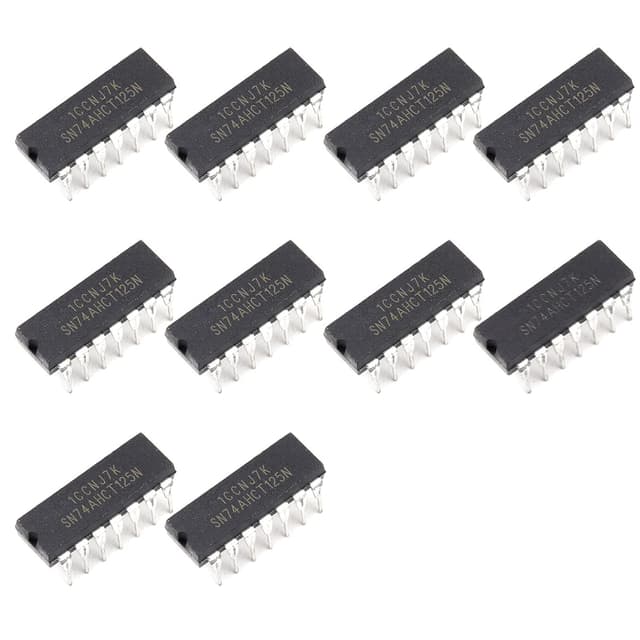
Bridgold SN74AHCT125N, 10 pack
The part the data-line arithmetic on every chip page ends at, from the listing with by far the most evidence behind it on this marketplace - 86 reviews at 4.7 and 400+ bought in the month to 2026-09-01, against single-digit review counts on the rest of the results. Ten chips because that is how this part is sold; one run needs one.
What else is worth knowing
Eight bytes before the first pixel
The current codes are not stored on the strip and not set by a resistor. They ride at the head of every frame - four values and their complements, one pair per channel - so a controller that does not send them is a controller the strip has not been told what to do with. That is also why the setting is the same for every IC on the run: there is one broadcast, not a value per pixel.
20 pixels per metre on 12V, 10 on 24V
One IC drives 3 LEDs on the 12V reel and 6 on the 24V one, so the same part number at the same 60 LED/m is two different pixel counts. A 5 m reel is 100 pixels at 12V and 50 at 24V. Every other chip here settles its pixel count at the factory; this one settles it at the rail you bought.
13 W with every LED off
Over 5 m at 60 LED/m the strip draws 13 W showing nothing at all, against 5.7 W for the WS2814 on the same run - one IC per 3 LEDs is a lot of ICs to keep awake. It is a floor under every number on this page, and the current setting does not touch it: it is the ICs being powered, not the LEDs being lit.
Every listing understates it
The reels are sold quoting 14.4 to 19.2 W/m, and the bench reads 22.1 W/m on a strip driven by WLED - 15% over the most generous of them. The listing is not lying so much as quoting a different current, which nothing on the page names. Size from your controller's setting rather than from the box.
Questions
How much power does a TM1814 strip use?
22.1 W per metre at 60 LED/m with all four channels at full white, which is 110.7 W over a 5 m reel - 9.22 A on 12V or 4.61 A on 24V. That is the draw at WLED's 22.5 mA setting. Set to the chip's 38 mA ceiling the same reel wants 185.1 W, and at the 6.5 mA minimum 33.9 W.
What size power supply does a 5 m TM1814 reel need?
132.8 W on WLED - full white plus the usual 20% margin - and the same on either rail, because the rail changes the current rather than the watts. Size it for the ceiling instead and it is 222.1 W, which is where Adafruit's advice to put a 12V 20A supply on a 5 m reel comes from: that figure is the chip at 38 mA, not the chip as your controller drives it.
Why does my TM1814 draw more than the listing says?
Because the listing quotes a lower current than your controller sets. Reels are sold quoting 14.4 to 19.2 W/m and WLED drives them at 22.1 W/m, so a supply bought against the box is 15% short before anything else goes wrong. It is the one chip here where the number printed on the product is not a property of the product.
Can I make a TM1814 draw less?
Yes, and it is the only chip here where that is true without dimming. Lowering the current setting lowers the draw in proportion - 64 steps from 6.5 to 38 mA, a range of 5.5x - and the strip is genuinely dimmer for it rather than PWM-dimmed. On WLED you cannot: the 22.5 mA is hardcoded and not exposed in the settings, so lowering it means another controller or a patched build.
TM1814 or WS2814?
Both are addressable RGBW on 12V and the WS2814 is the easier part to own: it draws 81 W over 5 m against this chip's 110.7 W, it needs no current setting sent to it, and its pixel count does not change with the rail. The TM1814 earns its place where the current being settable is worth something - capping a run's draw below what a WS2814 will ever pull, on a controller that lets you set it. One feed reaches 3.5 m here against 4.25 m on the WS2814.
12V or 24V TM1814?
The same watts either way - 22.1 W/m on both, because the 6-LED groups on 24V put twice as many dies behind the same current. What changes is reach and resolution: one feed covers 3.5 m at 12V and 7 m at 24V, and the 24V reel addresses in 6s where the 12V one addresses in 3s. Long run, take 24V; anything where a 6-LED block would read as a block, take 12V.
Every figure on this page is computed from the same engine the PSU calculator runs on. The per-LED draw behind them is measured rather than taken from a datasheet - QuinLED's LED power usage charts, 24V sheet v1.07, a reel of 300 LEDs driven by WLED. The current levels are the TM1814 datasheet V1.0 and the values WLED and Adafruit's library actually send. Other chips: the chip reference.