WS2811 power consumption
A 12V WS2811 draws 14.7 W per metre at 60 LED/m with all three channels at full white, or 73.5 W over a 5 m reel, which is 6.13 A on the rail against the 12.12 A the same light costs on a 5V WS2812B. What catches people out is that the WS2811 is a driver IC rather than a pixel, so the part number is sold as two different strips: the 12V reel almost everybody means, where three LEDs sit in series across the rail and are addressed together, and a 5V one that addresses every LED, which is where most of the figures quoted for this chip online come from. The grouping is also why it derates the ordinary way - colour effects measure 29.2 W against 73.5 W at full white, where the WS2815 on the same rail regulates each LED down individually and draws as much for a solid colour as for white.
What it draws
A 12V reel with all three channels lit, measured at 60 LED/m and applied per LED to the other densities. The pixel column is a third of the LED column, which is the number your controller wants; power is drawn per LED, so the larger one sizes the supply. The supply column is full white plus a 20% margin.
| Density | Length | LEDs | Pixels | Full white | Effects | Current at 12V | Supply |
|---|---|---|---|---|---|---|---|
| 30/m | 1 m | 30 | 10 | 7.3 W | 2.9 W | 0.61 A | 8.8 W |
| 30/m | 2 m | 60 | 20 | 14.7 W | 5.8 W | 1.22 A | 17.6 W |
| 30/m | 5 m | 150 | 50 | 36.8 W | 14.6 W | 3.06 A | 44.1 W |
| 30/m | 10 m | 300 | 100 | 73.5 W | 29.2 W | 6.13 A | 88.2 W |
| 60/m | 1 m | 60 | 20 | 14.7 W | 5.8 W | 1.22 A | 17.6 W |
| 60/m | 2 m | 120 | 40 | 29.4 W | 11.7 W | 2.45 A | 35.3 W |
| 60/m | 5 m | 300 | 100 | 73.5 W | 29.2 W | 6.13 A | 88.2 W |
| 60/m | 10 m | 600 | 200 | 147 W | 58.4 W | 12.25 A | 176.4 W |
| 144/m | 1 m | 144 | 48 | 35.3 W | 14 W | 2.94 A | 42.3 W |
| 144/m | 2 m | 288 | 96 | 70.6 W | 28 W | 5.88 A | 84.7 W |
| 144/m | 5 m | 720 | 240 | 176.4 W | 70 W | 14.7 A | 211.7 W |
| 144/m | 10 m | 1440 | 480 | 352.8 W | 140.1 W | 29.4 A | 423.4 W |
For a length or density not on this table, the PSU calculator runs the same figures for your own configuration and picks a supply against them. The 144 LED/m rows are the generous ones - the reel-density section has the measurement.
Why it colours three at a time
The WS2811 is a driver IC sitting beside the LEDs rather than inside one, and it has three constant-current output channels - one for red, one for green, one for blue. On a 12V strip each of those channels carries 3 dies of its own colour wired in series. Three green or blue dies stacked that way want most of a 12V rail to light at all, which is more than a 5V rail has to give.
So the grouping is not a design decision anybody made about effects resolution. It is what the rail buys: the strip cuts every 3 LEDs and colours every 3 LEDs because that is the smallest thing on it wired as a unit. A 5 m reel at 60 LED/m is 300 LEDs and 100 pixels.
Enter 300 where 100 belongs and nothing errors - the controller addresses the first third of the strip and leaves the rest dark, with every effect running over a third of the length you laid out. That reads like a broken strip or a failed data line, which is why it costs people an evening.
The same wiring is why this chip derates the ordinary way. Series dies leave no excess voltage to dispose of per LED, so what is not lit is not drawn: colour effects measure 29.2 W against 73.5 W at full white. The WS2815 on the same rail puts one LED per pixel and regulates each one down from 12V, burning the difference as heat - which is why it draws as much for a solid colour as for white and cannot be sized down for effects at all. Two 12V chips, opposite sizing rules, and the reason is how the LEDs are wired rather than what the rail is.
Denser reels draw less per LED
Three WS2811 reels were measured, and the draw per LED falls as the reel gets denser - the widest density spread the bench sheet has for any one chip. Every table on this page sizes from the 60 LED/m figure, because that is what the calculator sizes on and the two are not allowed to disagree.
| Density | Measured per LED | Measured per metre | This page quotes |
|---|---|---|---|
| 60/m | 0.2447 W | 14.7 W/m | 14.7 W/m |
| 96/m | 0.2005 W | 19.2 W/m | 23.5 W/m |
| 144/m | 0.1853 W | 26.7 W/m | 35.2 W/m |
At 144 LED/m each LED draws 24% less than it does at 60 LED/m, so a dense reel sized from this page comes out about 32% over-provisioned. That is the safe direction to be wrong in and it is worth knowing before buying a supply a third larger than the strip needs. It cuts the other way going sparser: there is no bench reading below 60 LED/m, and the trend says a sparse reel may draw slightly more per LED rather than less, so treat the 30 LED/m row as the estimate it is.
How far one feed reaches
How much strip one pair of power wires covers before the far end is visibly under voltage. This is the number 12V is bought for: the same light on a 5V strip pulls 12.12 A where this pulls 6.13 A, and current is what the strip's own copper cannot carry very far.
| Density | Per metre | One feed reaches | That feed carries |
|---|---|---|---|
| 30/m | 7.3 W/m | 5 m | 3.06 A |
| 60/m | 14.7 W/m | 4.25 m | 5.21 A |
| 144/m | 35.3 W/m | 3.5 m | 10.29 A |
Past that distance the run needs a second feed rather than thicker cable, because the loss is in the strip's own trace and no wire outside it can fix that. The power injection guide works out where the feeds go, and the drop guide separates that loss from the one in the cable.
Wire gauge, per feed
At 60 LED/m one feed carries 5.21 A. This is the wire from the supply to that feed, sized to keep the loss in the cable itself under the target - not the strip's own copper.
| Supply to feed | Current | Gauge | Lost in the cable |
|---|---|---|---|
| 1 m | 5.21 A | 18 AWG | 1.82% |
| 2 m | 5.21 A | 18 AWG | 3.64% |
| 3 m | 5.21 A | 16 AWG | 3.43% |
| 5 m | 5.21 A | 14 AWG | 3.6% |
The wire gauge calculator does this for any current and distance, and names cable that carries it.
Against a WS2812B
The same controller in two packages, over the same job: 5 m at 60 LED/m. The rows that decide it are the second and the last.
| WS2811 (12V) | WS2812B (5V) | |
|---|---|---|
| Full white over 5 m at 60 LED/m | 73.5 W | 60.6 W |
| Current that draw puts through one feed | 6.13 A | 12.12 A |
| Running colour effects | 29.2 W | 21.1 W |
| Draw with every LED off | 6.3 W | 1.5 W |
| One feed reaches | 4.25 m | 2.13 m |
The WS2812B is this same WS2811 controller built into the LED package, so the protocol and the timing are identical and a controller does not care which it is driving. What differs is the strip: the 12V reel draws 6.13 A where the 5V one draws 12.12 A for the same light, and one feed reaches 4.25 m against 2.13 m. What you give up for that is resolution - every 3 LEDs against every one. Strip types compares the rest of the families.
Driving its data line
The datasheet gives the threshold as 3.5 V on DIN, stated as a guaranteed minimum. An ESP32 or ESP8266 puts out 3.3 V, which is 0.2 V short of it. That is out of spec and it usually runs anyway, which is what makes it worth fixing before a long run or a cold room finds it: a 74AHCT125 takes the signal to 4.4 V guaranteed.
The 12V on the reel never reaches that pin. The WS2811 is rated for a logic supply of 6.0-7.0 V at most while its outputs drive the 12V side, so the strip regulates down for the IC and the threshold follows the regulated rail rather than the one you wired in. The chip reference carries the same figure for every chip that publishes one.
Where to get a 74AHCT125
One part for every chip on this site, because the two controllers WLED runs on are both 3.3V. Sourced by part number rather than by searching for a level shifter, which returns the wrong one.
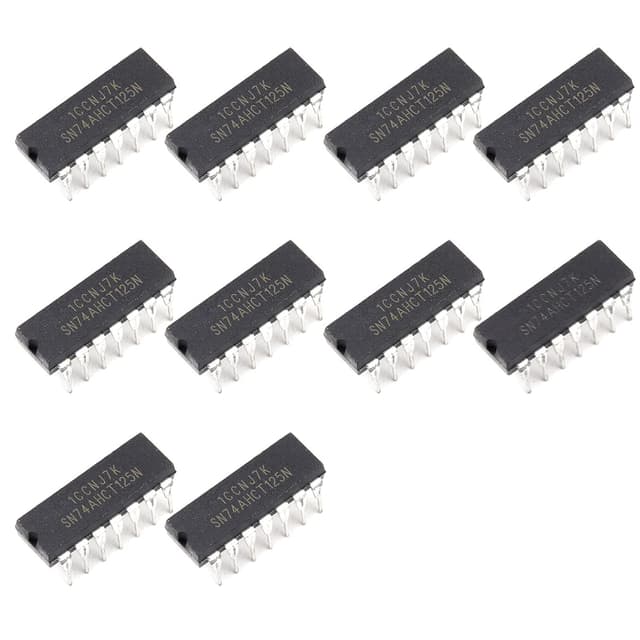
Bridgold SN74AHCT125N, 10 pack
The part the data-line arithmetic on every chip page ends at, from the listing with by far the most evidence behind it on this marketplace - 86 reviews at 4.7 and 400+ bought in the month to 2026-09-01, against single-digit review counts on the rest of the results. Ten chips because that is how this part is sold; one run needs one.
What else is worth knowing
The 5V WS2811 is a different strip with the same name
Nothing can be put in series on a 5V rail, so a 5V WS2811 drives one LED per output and addresses every LED, which makes it a WS2812B in all but packaging - the WS2812B is this same controller built into the LED itself. Every figure on this page is the 12V reel. Check the rail printed on your own strip before comparing it against a number found elsewhere, because the two parts share a name and very little else.
6.3 W with every LED off
Over 5 m at 60 LED/m the strip draws 6.3 W showing nothing at all, which is the ICs rather than the LEDs and is therefore a floor under every figure here. Left powered around the clock that is about 55 kWh a year before anything is lit.
It is the 12V chip that derates the ordinary way
Colour effects measure 29.2 W against 73.5 W at full white, or 40% - so a WS2811 that genuinely never shows white can be sized below its full-white figure, which on this rail is the exception rather than the rule. The WS2815 and GS8208 sold beside it regulate each LED down from 12V and burn the difference off as heat, so they draw as much for a solid colour as for white and cannot be sized down at all. Series wiring is the whole difference: there is no per-LED excess to burn.
Questions
How much power does a WS2811 strip use?
14.7 W per metre at 60 LED/m at full white, 7.3 W/m at 30 LED/m, and 26.7 W/m measured at 144 LED/m. A 5 m reel at 60 LED/m is 73.5 W, or 6.13 A on the 12V rail. The 60 LED/m figure is a bench reading of a 12V reel rather than a datasheet number, and the other densities are that per-LED draw applied to them - which holds better going sparser than denser, for the reason in the reel-density note above.
What size power supply does a 5 m WS2811 reel need?
88.2 W at 60 LED/m - full white plus the usual 20% margin - and 44.1 W at 30 LED/m. This chip does derate, so a strip that genuinely never shows white can be sized nearer its 29.2 W effects figure, at the cost of browning out the day somebody turns white on. The 144 LED/m row is the one to treat as generous: see the reel-density note above.
WS2811 or WS2812B?
They are the same controller. The WS2812B is a WS2811 built into the LED package, which is why the protocol and the timing are identical and a controller does not care which it is driving. What differs is the strip around it: the 12V WS2811 puts 3 LEDs in series per channel and addresses them as one, drawing 6.13 A over 5 m where the 5V WS2812B draws 12.12 A for the same light, and one feed reaches 4.25 m against 2.13 m. WS2811 for length, WS2812B for per-LED control.
How many pixels should I set for a WS2811 in WLED?
A third of the LED count. One IC drives 3 LEDs on a 12V reel, so 60 LED/m is 20 pixels per metre and a 5 m reel is 100 rather than 300. The LED count is the number printed on the listing, which is why it is the one people enter first, and entering it is why an effect stops a third of the way along the strip. Power is still drawn per LED, so the larger number is the one to size the supply from.
WS2811 or WS2815?
Both are 12V and the WS2815 addresses every LED where this one addresses every 3, so the WS2815 is the one to buy where the grouping would show - anything close up, or an effect finer than 3 LEDs. The WS2811 is cheaper to run and easier to size: it draws 29.2 W on colour effects against 73.5 W at full white, where a WS2815 regulates each LED down from 12V and burns the difference off as heat, so it draws slightly more for a solid colour than for white and cannot be sized down for effects at all.
Every figure on this page is computed from the same engine the PSU calculator runs on, and the per-LED draws behind it are measured rather than taken from datasheets. Sources and method: QuinLED's LED power usage charts, 12V sheet v1.06. Other chips: the chip reference.